


01격동의 위기 극복과 골프계 지각변동을 돌아보며
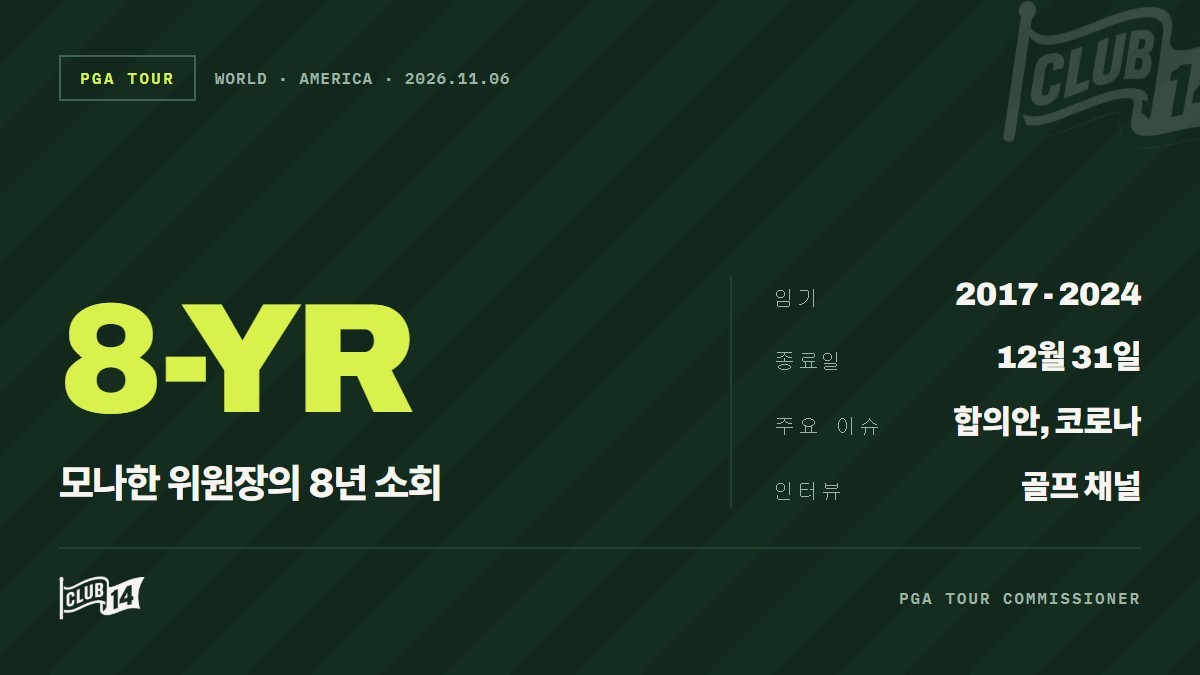
제이 모너한 PGA 투어 커미셔너가 자신의 재임 기간을 돌아보며 투어가 직면했던 주요 시련과 변화의 순간들에 대한 심경을 솔직하게 공유했다. 모너한 커미셔너는 수장으로서 이끌어온 PGA 투어의 성장과 향후 남겨질 유산에 대해 입을 열었다.
재임 중 가장 큰 도전 과제 중 하나는 전 세계를 덮친 코로나19 팬데믹 상황이었다. PGA 투어는 모너한 커미셔너의 지휘 아래 신속하고 철저한 방역 체계를 구축하며 주요 프로 스포츠 기구 중 가장 빠르게 대회를 정상적으로 재개하는 위기 관리 능력을 보여주었다.
또한 그는 사우디아라비아 국부펀드(PIF)와의 '프레임워크 협정(Framework Agreement)'을 언급하며 글로벌 골프계의 지각변동 속에서 내린 결단에 대해서도 솔직한 회고를 이어갔다. 모너한 커미셔너는 투어의 장기적인 안정성과 선수들의 이익을 최우선으로 고려했음을 강조하며 자신의 재임 기간을 종합적으로 돌아보았다.
02Original (English) — PGA TOUR
Jay Monahan opened up about several key moments during his decade-long run as commissioner of the PGA Tour, including the Framework Agreement, navigating the Tour through the COVID-19 pandemic and his legacy, during a wide-ranging interview with Eamon Lynch on Golf Channel.
Monahan was the debut guest on Lynch’s new show, “Eamon Lynch Has Questions,” which aired Thursday night.
Monahan spoke candidly about his time as commissioner, which began in 2017 and will conclude on Dec. 31. Among the highlights, Monahan helped secure a new media rights deal, negotiated the Strategic Alliance with the DP World Tour, spearheaded the creation of PGA Tour Enterprises and helped secure the accompanying investment by the Strategic Sports Group.
Monahan also led the Tour through several key inflection points. He was the driving force in the consummation of the Framework Agreement, a deal that was negotiated privately with the Public Investment Fund of Saudi Arabia. The agreement was announced live on CNBC on June 6, 2023, and stunned the golf world.
“Having been through this conflict for as long as it had been going on at that point in time, knowing that the direction of men's professional golf was under the umbrella and under the control of the PGA Tour was a very important outcome,” Monahan told Lynch. “I was seeking to end a damaging divide in men's professional golf. I felt like we had accomplished that, and I felt for the players and for everybody who believed in the model of the PGA Tour, that would ultimately be validation. At the same time, I realized that there was a lot of work that needed to be done. It was a framework.”
Monahan described being excited when the Framework Agreement was announced. However, it faced opposition from inside and outside the PGA Tour, which had spent several years competing with the entity it was now agreeing to negotiate with. Monahan said the rollout of the announcement was the biggest regret of his tenure as commissioner.
“Because I mishandled the communication, because the rollout was a failure, that ended up prolonging all of that,” Monahan said. “... Anything as it relates to the way that was handled, or the way people were surprised by that, that’s on me. Would I like to have that back? I would have liked to have had it back that day. But that’s not the way things work.”
The stress of the negotiations and the aftermath ultimately led Monahan to step away from the Tour to focus on his mental health. Monahan was away from the Tour for a month to address the issues. Monahan said he wasn’t sleeping, couldn’t go on runs without getting severely out of breath and knew he wasn’t in a good place.
“When you were in the situation that we were in, you want to project strength, because you believe in what you're doing, you believe in what you represent, you believe in what the outcome is going to be, even though you don't have all the answers, even though you don't have all the information,” Monahan said. “This had been going on for a long period of time, and it's all I could think about. It was every waking hour – and I wasn't sleeping for an extended period of time – spent thinking about where we were, where we needed to get to, what I was hearing. So when that day happened, and when the subsequent days unfolded, it was pretty clear that I needed to focus on myself.”
Monahan returned later that summer and resumed his work as commissioner. That included good-faith efforts with the PIF to reach a long-term agreement to unify professional golf. Those conversations continued through February 2025 when the two parties met at the White House alongside President Donald Trump. But that’s when it became clear a deal would not happen.
“I think this (was) the fourth time we had made a proposal, or we'd come with a recommendation on how to proceed, and it was very clear that that wasn't going to work,” Monahan said. “So the good news from that meeting is that it confirmed what we thought was going to be the outcome, and having Tiger (Woods), having Adam (Scott), having the president host the meeting, it was very clear that we needed to keep continuing to do what we were doing, which is focus on what we control, making the PGA Tour as strong as we could.”
In that respect, the Framework Agreement was a necessary step to end costly litigation and bridge the transition to creating the for-profit PGA Tour Enterprises, with Strategic Sports Group stepping in as the primary investor. Creating PGA Tour Enterprises was a critical moment in advancing the Tour to where it stands today, ready to debut a new competitive structure in 2028 with its players directly involved in the ownership structure.
Monahan’s decade-long tenure as commissioner also coincided with a global pandemic. The deadly virus caused the cancellation of the 2020 Players Championship after one round and the ensuing shutdown of the sports world. Monahan helped the Tour successfully return to play later that summer, the first major sports organization to do so.
Monahan spoke of those early days, deliberating with close confidants on how to bring the competition back while keeping everyone safe.
“So we went through a presentation one afternoon and by the end of it, a couple hours in, the players were like, ‘This is insane. Like, there's no way we can do this,’” Monahan said. “But it was helpful because by starting there, then you could start to pull back and figure out, okay, what is going to be acceptable – what's that balancing act of being acceptable enough to be able to get the players to play versus us being safe?”
Just three months after The Players Championship was canceled, play returned at the Charles Schwab Challenge at Colonial Country Club with the PGA Tour leading the way for a safe return to competition across the global sports landscape.
Monahan will retire as PGA Tour commissioner at the end of the year, though he will remain as board chairman for the First Tee. CEO Brian Rolapp will assume the role of PGA Tour commissioner on Jan. 1, 2027, the fifth man to hold the title, following Monahan, Tim Finchem, Deane Beman and Joe Dey.
Each commissioner has left a unique legacy. Dey guided the PGA Tour through its first years, setting it on the right path after the split with the PGA of America. Beman established the foundation of the PGA Tour’s competitive model, the creation of The Players Championship, and set the standard of charitable giving, which remains a bedrock of the business to date. Finchem modernized the business and helped transform golf into a massive global and commercial enterprise, coinciding with the rise of Woods.
What will Monahan’s legacy be? Lynch closed the interview by asking Monahan what he should be remembered for.
“History will determine what my impact or what my legacy was, and I'm very comfortable with that,” Monahan said, “because I gave everything I could to try and help the PGA Tour.”