
This article was machine-translated from the Korean original. Read the Korean original
There is a truly wide variety of putters. Today, I will summarize everything for you at once, from head shapes and neck types to the Zero Torque putters that have become the current trend, and even the sweeper-style putters sought after by those struggling with the yips.
01Head Shapes — Blade and Mallet
Putters with a straight, linear shape are called blades, while those with a thicker back are called mallets. Mallets have their center of gravity positioned towards the rear, so once the head moves, it tends to maintain that inertia. This makes the stroke more comfortable and improves consistency. It is helpful for beginners, those lacking consistency, and even professionals who might be swayed by pressure. Conversely, blades are better suited for players who rely more on feel.
02Neck shape and toe hang
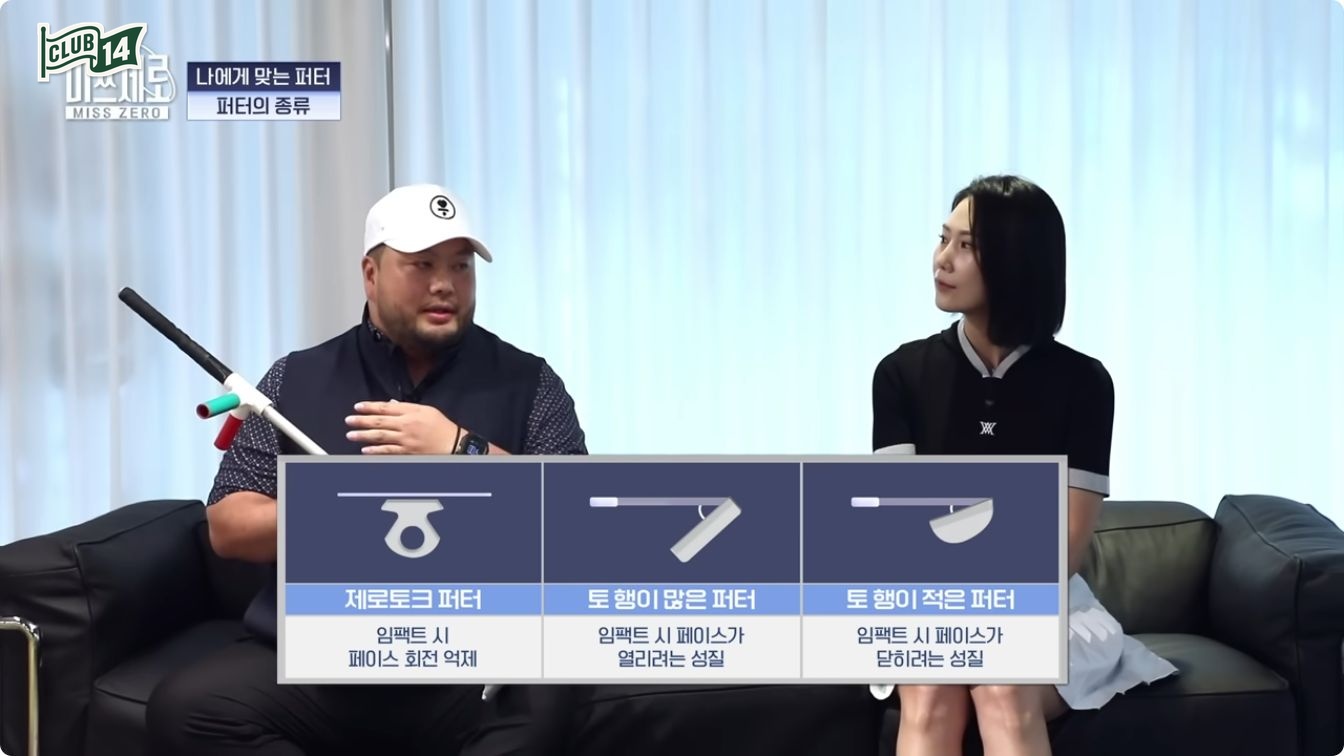
The part connecting the head and the shaft is called the 'neck,' and there are three main types: the angled plumber neck, the bending neck where the shaft curves as it enters after coming in a straight line, and the center shaft where it simply slides into the center of the face. The head's 'toe-hang' tendency varies depending on the neck type. The more toe-hang there is, the more the face tends to open during the stroke, causing the ball to tend to go to the right; conversely, the opposite tendency occurs with a greater toe-hang.
03The current trend, Zero Torque Putter
Since all putters are struck at a lie angle rather than a vertical one, a twisting force (torque) is generated in the club head. Often, when you try to relax your grip after hearing advice to "hit with less power," your hands end up being controlled by this twisting. However, the Zero Torque putter is designed to eliminate this torque entirely. Even when striking at a tilted angle, it keeps the club head pointing directly at the target without any tendency to open or close, thereby improving both direction and consistency simultaneously.
Since putters with a lot of toe hang tend to open, the Zero Torque putter can be helpful for those who open their putts too much or lack consistency. The Zero Torque has been out for about 6 or 7 years, but it has become a complete trend recently as Korean players started winning with it. I introduced it to players early on, and they all felt a bit awkward about it back then. But now, so many players are using it.
04What criteria should I use to choose a putter?
Advanced players and athletes have good technique, so there is a high probability that they will perform well even if they choose something they like. However, for amateurs, it is good to consider them by dividing them into two categories.
| division | Selection criteria |
|---|---|
| For beginners | Since you haven't mastered the correct posture yet, it is important to choose a putter length that matches the distance from the ground to your wrist when standing upright. It is also better to choose a simple head design rather than a complex one. |
| Those with experience | It is common for people to already have their own habits (posture) that are difficult to change. In such cases, rather than trying to change your posture, it is much more helpful to fit the length, lie angle, and loft to match your current posture. |
Custom putters are trending these days, and since everyone has a different body type and stroke pattern, customizing at least the length, lie angle, and loft definitely helps with performance.
05If you are struggling with the yips — Sweeper-style putter
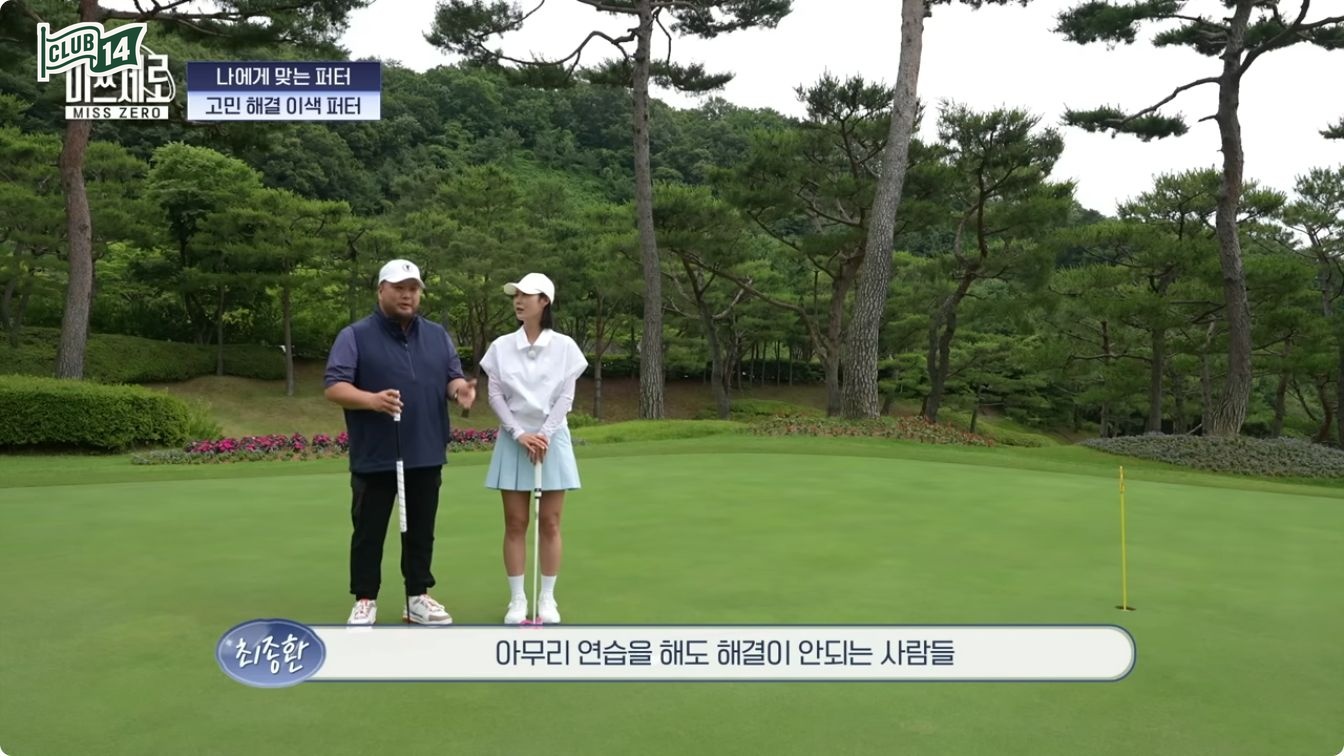
Putting is often compared to a pendulum motion. While traditionally you need to hold a short putter and make an effort to create a stroke that is close to a circle, the sweeper-type (re-putter) putter is structurally designed to already resemble a pendulum motion. Because of its long length and structure that extends up to the sternum, you can create a pure rotational stroke much more easily without manual manipulation.
However, this putter is not something just anyone can hold comfortably. When you first pick it up, it may feel awkward, and you might not know where to apply your force. I recommend it to those who truly struggle with putting, or those for whom the problem persists despite taking lessons and practicing. In fact, there are players whose putting rankings have significantly improved after switching to this putter, as well as those who recovered from the yips. It is also great for amateurs who find it difficult to bend over due to back pain—it is designed to allow for a comfortable stroke while standing.
06Organizing today
There is no single right answer when choosing a putter. However, if you first identify what type of player you are—whether you lack consistency, haven't established your stance yet, or are simply at a loss—one of the criteria outlined today will definitely be helpful. If you are unsure, I recommend trying it out in person at a store, and if possible, getting a fitting at least for the length.