
This article was machine-translated from the Korean original. Read the Korean original
Hello, this is Choi Jong-hwan. It is very common for not only amateurs but also professional players to confuse tempo and rhythm. People often say things like "make the tempo good" or "make the rhythm good," but I've noticed that many people don't actually know the difference between the two.
Let me summarize it simply. Tempo is the time it takes to return from the start of a stroke to impact. If that time is fast, it is a fast tempo; if it is slow, it is a slow tempo. Rhythm is the ratio of the time taken for the backstroke to the time taken for the downstroke within that tempo—in other words, the ratio of the backstroke speed to the downstroke speed.
01Good rhythm is — going back and forth like a pendulum
Having good rhythm means that the speed of the backward movement and the speed of the downward movement are similar, like a pendulum. Conversely, if the rhythm is bad, the downward speed suddenly accelerates compared to the backward movement, or vice versa.
The tempo can change slightly depending on the situation. It might speed up if the green is slow, or slow down if the green is fast. However, research shows that players who are good at putting always maintain a good rhythm even as the tempo changes slightly.
02The Tortoise and the Hare — Even if the tempo changes, the rhythm remains the same
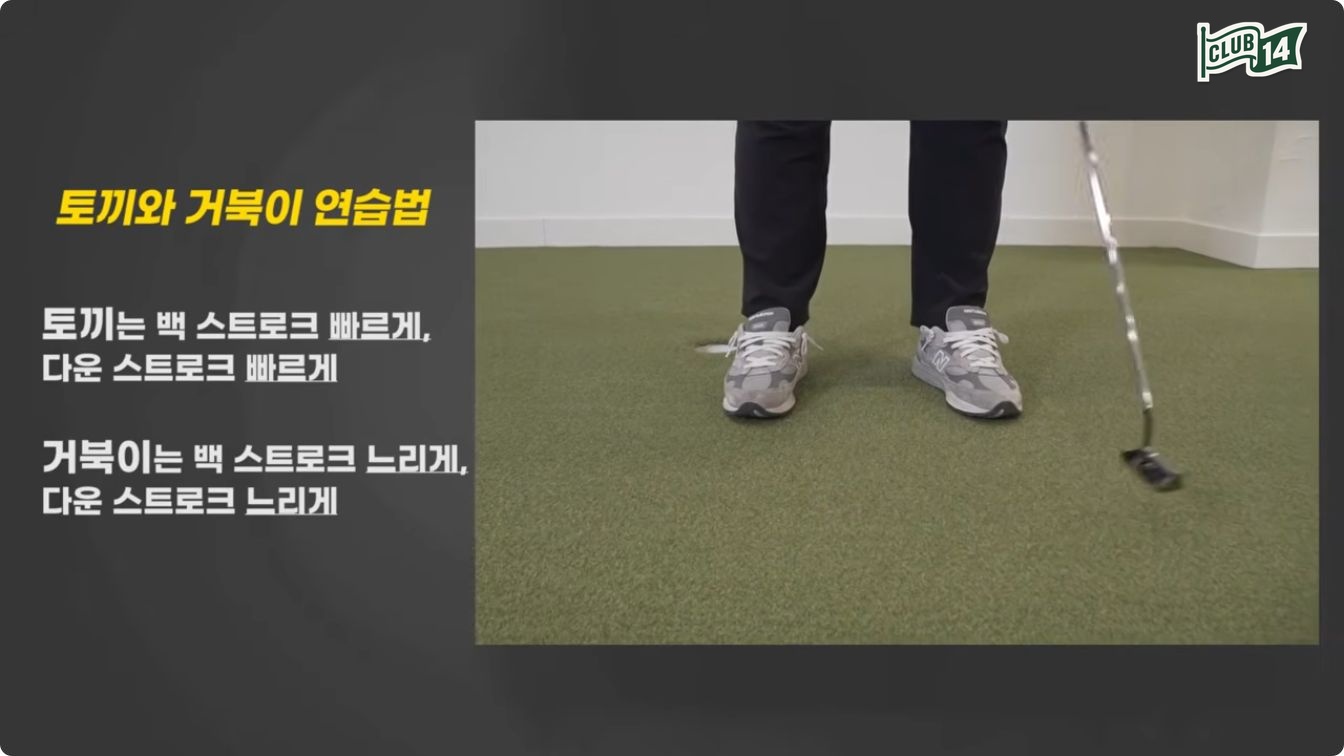
To explain this in an easy-to-understand way, I use the names "the rabbit" and "the turtle." Whether you go as a rabbit or a turtle is the tempo. If you go as a rabbit, come down as a rabbit; if you go as a turtle, come down as a turtle. This is the concept of rhythm. What we do not want is going as a turtle and coming down as a rabbit, or vice versa.
The reason rhythm is important is that the club face opens or closes at the moment the speed changes instantaneously. Ultimately, if your rhythm is poor, you will suffer in terms of direction as well. Conversely, if your rhythm is good, it becomes easier to control both distance and direction.

03Hands-on practice method — Three times on the same target
Even if you understand it with your head, you need practice to master it with your body. Hit the same target three times, but try hitting it differently each time.
- First: With a good rhythm, going quickly like a rabbit and coming down quickly.
- Second: With a good rhythm, going slowly like a turtle and coming down slowly.
- Third: At a size and speed that suits me, and with a good rhythm as well.
Since you have to send the ball the same distance, the stroke will be smaller when hitting with the rabbit and larger when hitting with the turtle. If you repeat this three times, you will get a feel for what a good rhythm is, and at the same time, it will also train you to adjust it in various ways.
It will likely be quite difficult to get all three right at first. However, if you set a goal, establish a system, and keep trying, there will eventually be a moment when you realize, "Ah, so this is how it works." Try doing this just three times on the practice green before your round today.