This article was machine-translated from the Korean original. Read the Korean original
Many amateur golfers spend a lot of time at the driving range practicing to improve their swing form. There is nothing wrong with that. However, one regrettable aspect is that they focus too much on practicing a swing designed to hit the ball straight. No matter how good your swing is, it is impossible to always hit the ball straight.
However, even if your swing is a bit lacking or not perfect, intentionally curving the ball in one direction is much easier than hitting it straight. As long as you can curve the ball in the direction you want, how pretty the shape looks isn't actually that important. So, the key point I want to convey today is this: Don't practice hitting the ball straight; practice curving the ball.
01Two principles for creating ball flight
Please remember just two things about how to curve the ball in the direction you want. First, your stance is where the ball starts, and the clubface is the target. Your stance is the direction you want to launch the ball, and the clubface is the direction you want to curve it. If you open your stance and open the face, the ball starts to the left and curves to the right, and if you close your stance and close the face, the ball starts to the right and curves to the left.
The second point is the key to today's lesson. The opening and closing of the club face, which determines the ball's trajectory, is not created by the swing or your hands, but by your left-hand grip. If you want to curve the ball to the right, use a weak left-hand grip. If you want to curve the ball to the left, use a strong left-hand grip.
02For those who are afraid of a left miss or a right miss
There must be many of you who really hate missing to the left—to the point of being afraid of it—and I was like that too. I also know very well those who feel like all the strength drains from their body when the ball flies to the right, and who feel that if there is water on the right side, it will definitely go in there. Because I was like that too.
So, I think of this method like this: You can use it as a way to avoid left-side misses for those who want to avoid them, and as a way to avoid right-side misses for those who want to avoid them.
03Check the grip method using the knuckles on the back of your hand.
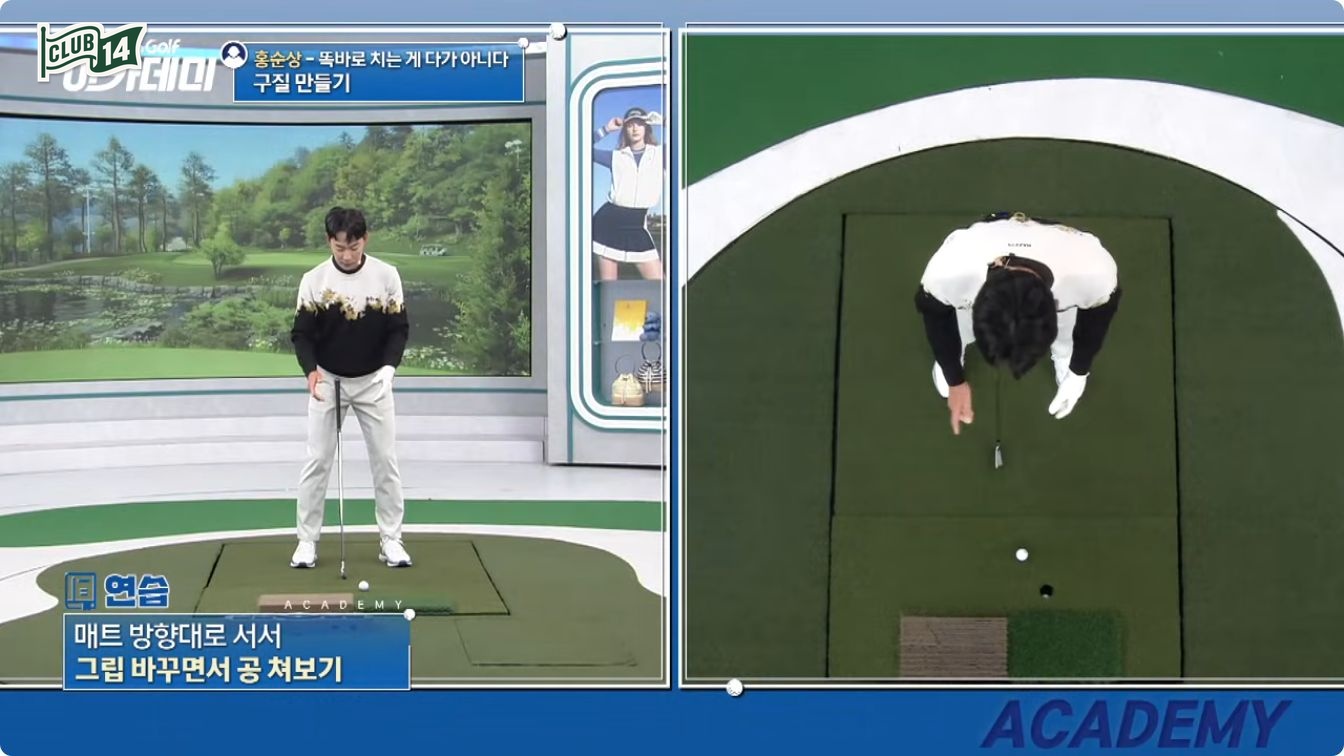
First, stand facing the mat. It is recommended that you try experiencing the ball curving solely by changing your grip, without worrying about the direction or amount of curve, and without altering your swing. Once you actually experience the ball curving like this, you will gain confidence.
A strong grip feels like covering the shaft with your palm. Typically, about three knuckles on the back of your hand are visible, and the V-shape formed by your thumb and index finger points toward your right shoulder. Doing this gives you the feeling that the clubface is closed at impact, even without using your hands extensively. If you are struggling with shots drifting to the right, simply switching to a strong grip can significantly reduce those errors.
With a weak grip, the back of the hand feels like it is facing the target more. You can see one or two knuckles on the back of the hand, and the V-shaped groove points towards the center of the body. Doing this gives you the feeling that the ball will hit with an open face if you don't use your hands during impact. For those whose balls curve too quickly to the left due to a strong grip, simply switching to a weak grip can make the ball fly slightly higher and take a fade.
Your right hand should naturally follow the left-hand grip. With a strong grip, feel as if your right hand is supporting from below, and with a weak grip, feel as if your right hand is covering your left. If you maintain the sensation of your thumbs overlapping, it creates a sense of unity in your hands, allowing your right hand to naturally follow your left.

04Deciding on the pitch and hitting it is itself a weapon.
You’ve probably had this experience at least once on the course. You’ve perfectly aligned yourself and are looking straight at the target, but suddenly you get this anxious feeling that the ball is going to go to the right or left. Then, if there is out of bounds on the right, you end up pulling to the left, and if something feels off on the left, you end up pushing to the right. Since you are well-aligned, the ball briefly follows the target line at launch, but ultimately, the shot is bound to end up moving away from the target.
However, if I can consistently hit a specific ball flight, I can create a shot that eventually returns to the target, even if the ball starts far from it. I believe you need to develop your ability to curve the ball more than your ability to hit it straight. No matter how perfect your swing is, if you hit the ball without keeping the flight path in mind, you are bound to struggle with your strategy.
It is generally considered the textbook strategy when the pin is on the right to aim for a safe space on the left and hit the ball to curve to the right. However, the reason this strategy is effective is not simply because you are looking for a safe space, but because you have determined the ball flight. Players with a truly solid ball flight actually aim for the bunker or water next to the pin. This improves the chances of landing on the green and avoiding hazards.
05Let me give you an example using my swing pass.
My swing path is slightly in-to-out, so I hit a draw even when I just swing normally. However, hitting a draw just by swinging is completely different from deciding to hit to the left. Actually, my in-to-out path is about 1 to 3 degrees; for instance, if I swing 2 degrees in-to-out, opening my stance by 2 degrees brings the trajectory to zero, while opening it by 4 degrees results in a 2-degree out-to-in trajectory. If the clubface is open on top of that, the ball curves to the right. So, to be precise, I am essentially hitting a push fade.
The most important thing for curving the ball to the right is ensuring the club face is clearly open at the moment of impact. Even if you try not to release, due to the weight and speed of the club and the structure of the hands hanging from the shoulders, the club face will inevitably close as the hands pass the shoulders unless the shoulders are pulled out along with the club. Therefore, the easiest way to maintain an open state until the moment of impact is a weak grip.
06Today's homework
If you have sufficiently practiced creating a certain ball flight just by changing your grip, it is now important to be able to hit this flight repeatedly. Today's homework is to first hit a draw that curves from right to left three times in a row.
If you succeed, boldly change your grip and try hitting three consecutive fades that curve from left to right. If you successfully hit a total of six in a row, today's homework is complete. It is natural that you may not get the feel for it at first. However, if you practice consistently for about a month, you will be able to feel your golf game improve to the next level.