
This article was machine-translated from the Korean original. Read the Korean original
On days when the driver is well, the irons are a mess, and on days when the irons feel right in your hands, you have no idea where the driver is going—I'm sure everyone has had this experience at least once. I was asked this question a lot throughout my tour career as well. Should a driver swing and an iron swing be the same or different?
To start with the conclusion, the basic principles of the swing are the same. It involves sufficient upper body rotation and leading the downswing with the lower body so that the club rotates out; this principle applies identically to both drivers and irons. There is no rule saying that you must hit a driver with your arms and an iron with your body.
01But why does it feel different? — Three differences
The head shapes are different, for starters. The driver is designed to hit the ball the farthest among my clubs, while the irons are made for the most accurate shots. In short, the driver is for distance, while the irons are for accuracy and control.
The second factor is length. As you move toward a driver, the shaft gets longer, increasing the distance from the ball, and the slope created by the shaft becomes gentler when viewed from the side. Irons, being shorter and closer, have shafts that are more upright. This slope directly affects your swing path.
The third factor is the impact condition. For a driver, the best trajectory, distance, and spin are achieved when the club head strikes the ball as it passes its lowest point and begins to rise; for an iron, the ball must strike as the head descends, with the lowest point occurring afterward, to achieve an accurate impact and spin that stops the ball on the green.
02Address is reserving the ball I will hit in advance.
I often see people at the driving range swinging in a way that doesn't align with this design intent. There are those whose swings are so flat that the club head practically moves back and forth in front of their eyes, and others who make a loud thumping sound as they hit the ground from the moment they strike an iron. If you prepare with this kind of address, you are essentially creating a stance that is conducive to hitting down on the ball, even when holding a driver. I have only one point to make: the address is reserving the ball you are going to hit.
If you place the ball too close to the center, the trajectory becomes low, resulting in a loss of distance. Trying to force the ball airborne with an iron is particularly noticeable when clearing water or bunkers. If your head moves too much during the backswing and fails to return to its original position, it leads to topping or hitting behind the ball. All of these issues depend on just one aspect of your setup.
03Driver Settings: Just Remember These Three
- ball positionPlease place it on the line of the left heel.
- weightLoad a little more onto the right side, roughly 4:6.
- gazeAbove the target line—please look at the netting in the middle of the range, a tree, or a cloud. Much higher than the actual trajectory, I aim for a point that feels like about 45 degrees.
Creating this kind of angle also helps reduce spin. People who slice frequently usually have a lot of spin, and the amount of spin is reduced when the club pad enters the ball squarely or inside. However, trying to create this manually is likely to have a counterproductive effect.
04If you slice a lot — try pulling your right foot back slightly.
There is a practical method to flatten your swing path without changing your swing. It is a technique I frequently use in tournaments: stepping your right foot back to open your stance. It may look like your foot is pushed far back, but the ball doesn't curve as much as you might expect. This is because the alignment of your upper body and pelvis is more important than your feet. It is a simple enough method to try out on the course right now.
As a final tip, ever since I was a junior, I have swung with the image of driving a nail into the ball. When you drive a nail, you don't hold back your strength; you pour out 100% in that moment. Adopting this image helps you learn the sensation of fully transferring your power to the ball, and by thinking less about the technical aspects of the swing, it actually helps you achieve maximum speed.
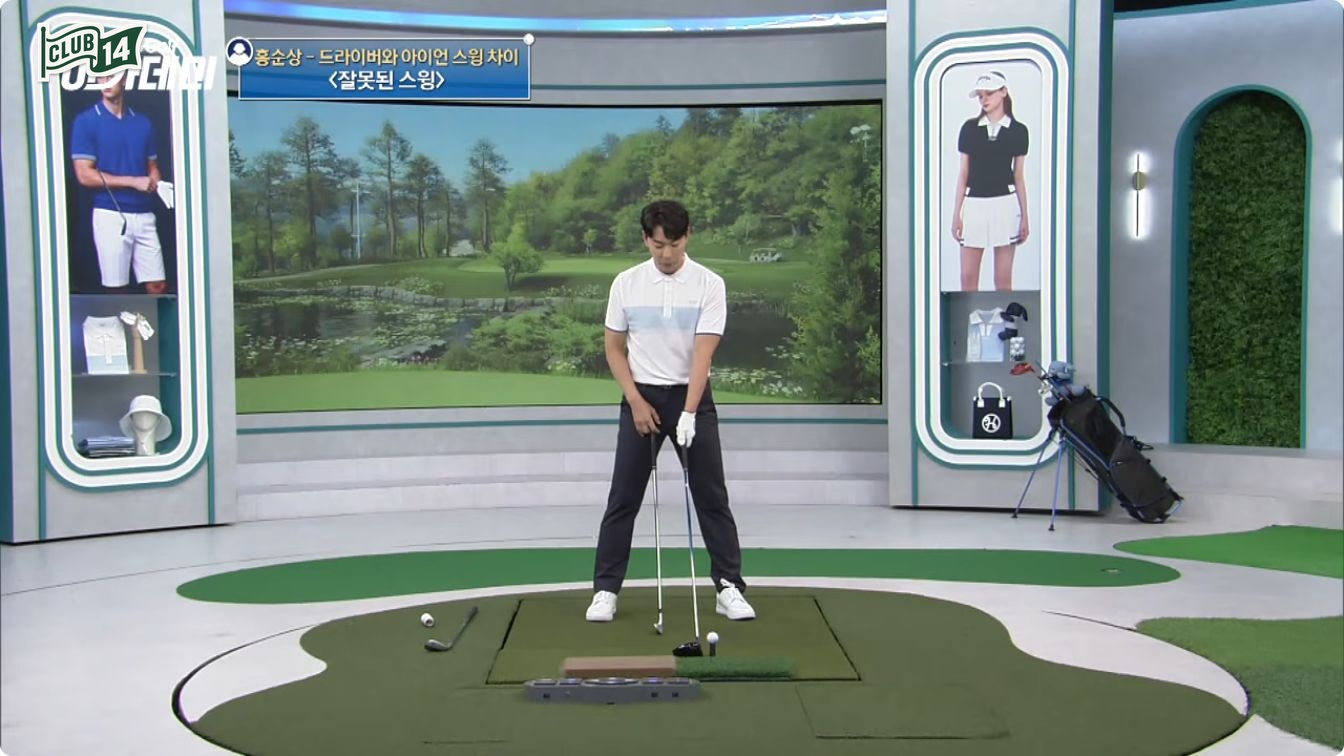

05Iron Setup — You need to understand the feel of the downblow first.
For irons, a 50/50 weight distribution and a ball position in the center or slightly to the left is sufficient. You don't need as much spinal tilt as with a driver; a natural tilt resulting from holding the club with your left hand lower than your right is enough. Above all, it is important to first understand the feeling of hitting with a downswing. Without this sensation, you won't have a standard to judge for yourself whether you hit the ball "pressed down" or "lifted up" today.
Here is a practical method I frequently use in matches or rounds. When I take my address, I slightly lift my right heel. This keeps my weight on my left foot and creates the sensation of rotating in place without shifting my head position. During a full swing, you can continue this by feeling like you are stepping on the outer front of your toes. Mastering the sensation of rotating in place without changing your head position is the key to keeping your head in a good position during the downswing.
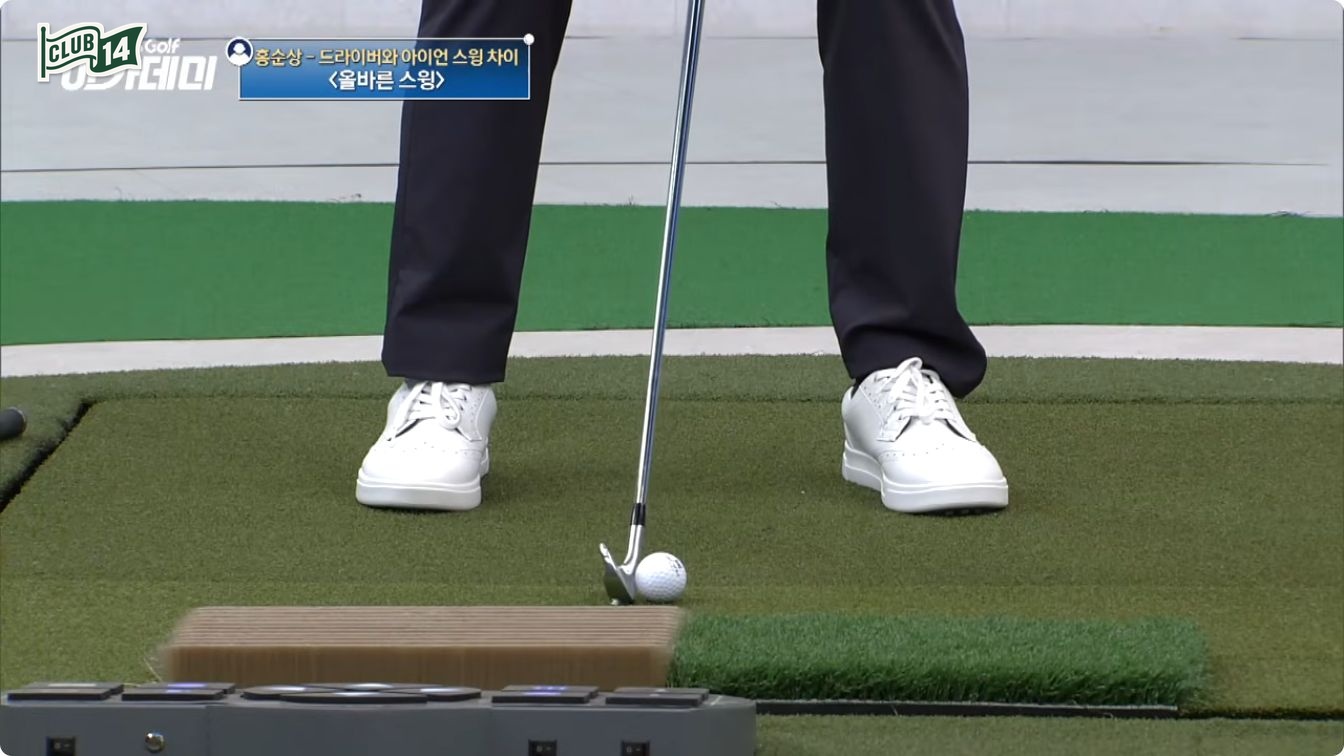
Once you have gotten the hang of it, practicing with bandages is also a good idea. Place a bandage about two ball widths behind the ball and practice hitting it without touching it. Once you are comfortable with this, try narrowing the distance to about one ball width. However, do not place it any closer than that—if it gets too close, you might end up taking a different swing while trying to avoid the bandage.
06Conclusion — Don't change the swing, change the settings.
The reason your irons are a mess on days when your driver hits well, and vice versa, might be that you are trying to use different swings for the two clubs. If you look at any professional golfer, their driver and iron swings do not appear different. Focus only on your initial setup and try to maintain the feeling that the swing is exactly the same for both clubs. You are more likely to hit well that way.

07Today's homework
- DriverFind a tee box with a mirror and complete your address with these three preparatory movements: ball position, weight on 6, and looking upward along the target line.
- IronIf you put a bandage on the back of the ball and create a clean down-blow feel without touching it twice in a row, you have succeeded.