This article was machine-translated from the Korean original. Read the Korean original
You have likely heard a lot of putting advice such as keeping your head still, your lower body still, and your wrists still. However, among these, the advice I consider the most dangerous is to keep your wrists still.
01There are no players with completely fixed wrists.
These days, there are many devices available that can observe wrist movements. If you attach a sensor to check, you will find that no matter how skilled a player is, there isn't a single one whose wrist movement is completely zero. Everyone has some movement. The only difference is that there is good movement and bad movement, and whether it is used appropriately at the necessary timing or excessively at points where it shouldn't be used. And consistency is also important.
02Three wrist movements — vertical, horizontal, and rotational
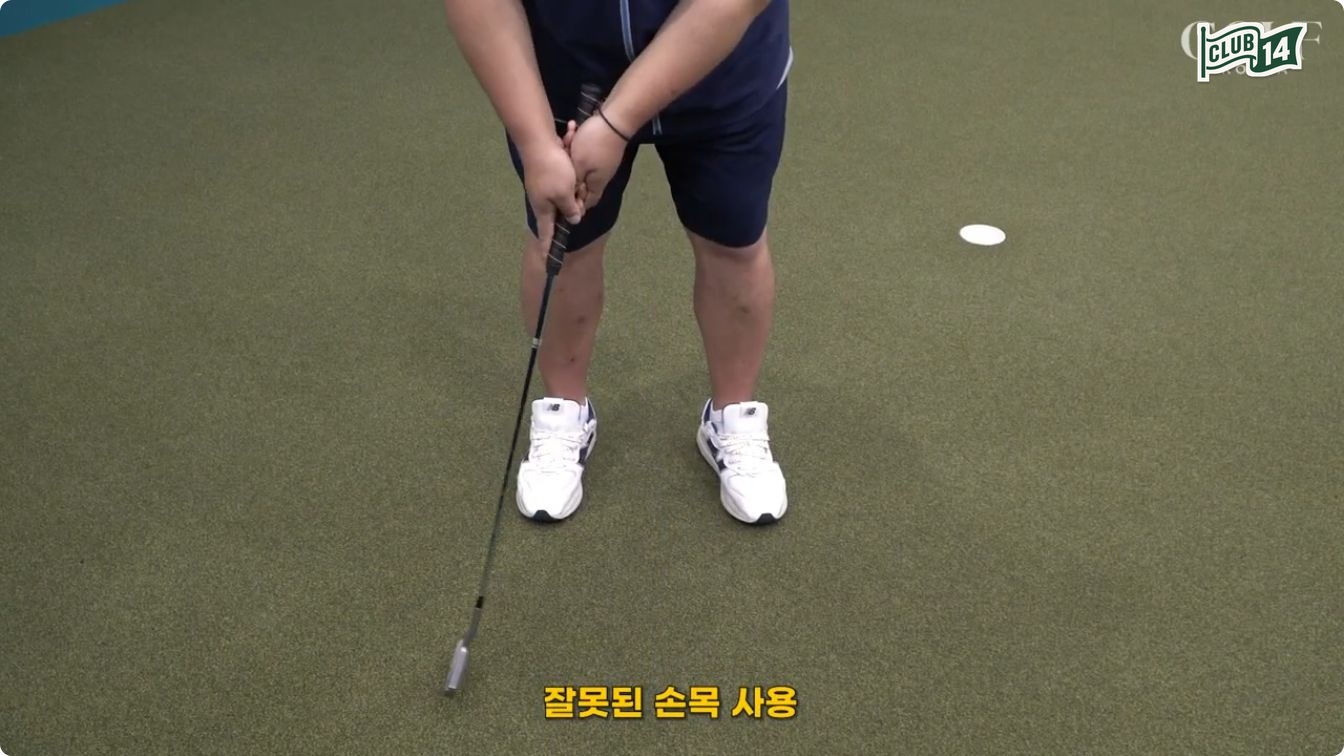
Wrist movements can be broadly divided into three types: vertical movement, where the wrist bends up and down when viewed from the side; horizontal movement, where it bends left and right when viewed from the front; and rotational movement, where the entire forearm rotates.
Among these, the rotational twisting motion of the shaft and the vertical bending motion are not very good for putting. Rotational motion makes the direction inconsistent, and vertical movement of the head causes the impact point and the path the head takes to become irregular. Therefore, it is best to maintain these two angles exactly as they are in the address position.


03The problem is horizontal movement — timing is key.
Regarding the remaining point, most amateurs frequently use horizontal wrist movement at points where it shouldn't be used. That is why advice to keep the wrist fixed is given. However, as you progress to higher levels, this wrist movement appears naturally at both ends of the stroke—that is, at the point where the direction changes. It is similar to how tension is slightly released at the peak of a change in direction when pulling a fishing line.
You should maintain a firm grip, but allow a slight degree of freedom for your wrists. I don't mean to swing wildly; if you can feel the subtle movement of your wrists at both ends, that is a good rhythm. Conversely, if that change occurs too suddenly or if the wrists bend excessively in the opposite direction during the backswing, it is not a good rhythm.
The point where most amateurs make a mistake is when they try to keep their wrists fixed, only to end up using them excessively during the impact zone. At that moment, the angle changes, leading to directional or point errors. Therefore, once you have determined the direction you want to send the ball, try striking with a firm grip while allowing a slight degree of freedom for your wrists. That will create a much better feel.