This article was machine-translated from the Korean original. Read the Korean original
Nowadays, as long as you have a mobile phone, you can find the world's best lesson videos anytime, anywhere. However, since some people tell you to do it this way and others tell you to do it that way, you may actually find yourself confused at times.
However, I believe there is one coach who costs nothing, requires no reservation, and always tells me only the truth without any lies. It is the ball I hit. The ball doesn't teach us, but it continues to tell us through its results. If you can read this message well, your golf game can definitely change.
01The ball always teaches two things.
Every time we hit the ball, it tells us two things. The first is the result—things like whether it went to the right, to the left, or went up. However, most of the time, the verification ends there. The second thing the ball tells us is the cause. It even tells us why it was hit that way.
With the advancement of swing analyzers and launch monitors, things that were previously guessed at based on a coach's experience are now verified by data. There is something you need to keep in mind here: the club face determines the ball's launch direction, while the club head's trajectory determines the amount and direction of the curve.
02The most common cause of inconsistent trajectories
Many amateur golfers have excessively out-to-in or in-to-out swing paths. As a result, they tend to produce a significant amount of curve. If you can hold your club path a little more stably and consistently, you will be able to hit much more stable shots.
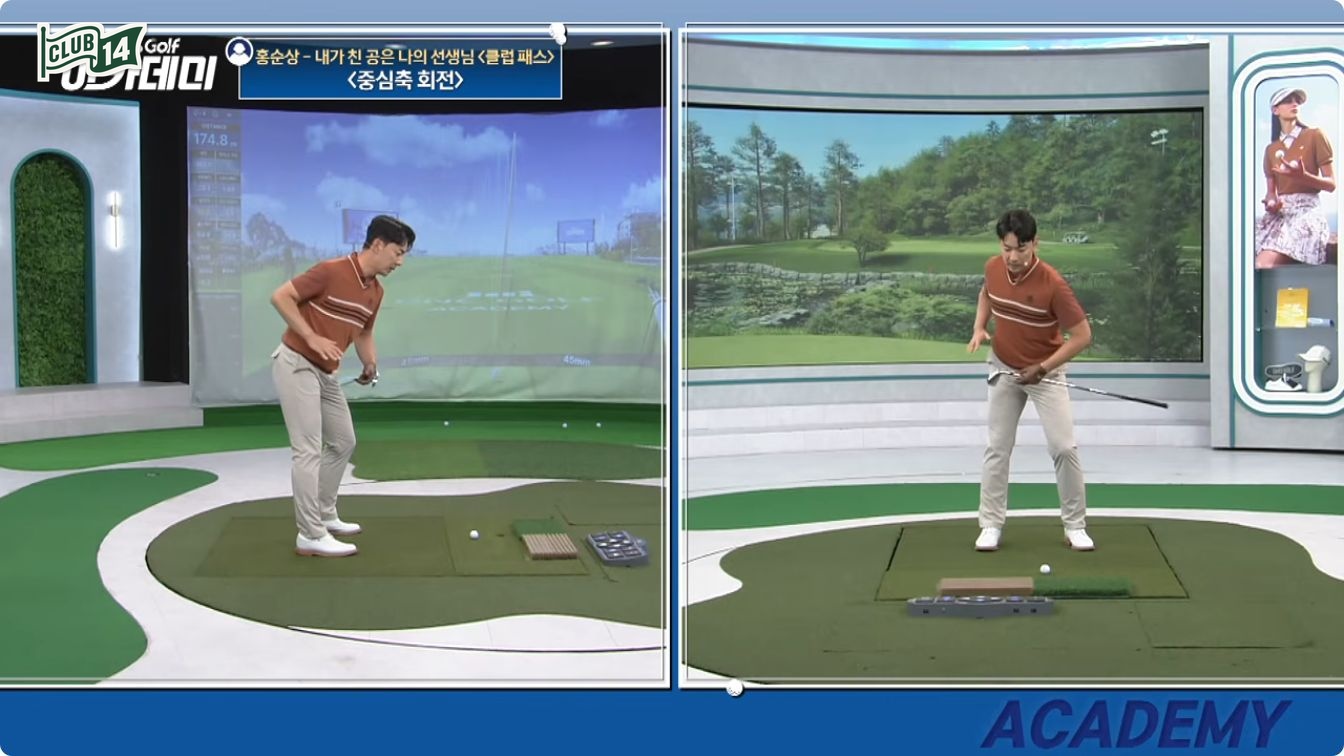
If I had to pick one of the most common causes I've seen, it would be rotating around the right side of the body as the axis, rather than the center. When you rotate around the center of the body, the right hip moves backward along with the left hip moving forward during the backswing. If you imagine extending your spine and fixing it to the ground, you can rotate as much as you want while this axis remains fixed.
However, if you rotate using the right side as the axis, the position of the right side does not change, and only the left hip moves forward. Then, during the downswing, rotation occurs around the left hip that is already forward, resulting in an early extension phenomenon where the upper body lifts.
03It is like this if explained with a compass.
It is easy if you imagine a compass. When you rotate around your center of gravity, your right side moves backward as much as your left side moves forward. At this time, if there were a wall behind you, you can maintain your spine angle exactly as it was when you first stood by feeling as if your right hip were touching the wall.
Conversely, if you rotate around the right axis, the club lags and is dragged in, and the motion of trying to force balance by rotating your hands often results in hooks or hitting the ground behind the ball. While professionals may rotate more or less depending on their flexibility, one thing they all have in common is that they rotate around the center of their body as an axis. Top players, in particular, maintain this axis well, which is why their backswing angle appears deep.
04Early extension isn't a bad move, it's a timing issue.
The term "early extension" itself might sound like a bad movement, but in fact, the extension motion is absolutely necessary for our bodies to generate power. The problem is the timing. If you rotate to the right during the backswing instead of rotating around the axis, this timing becomes too fast.
By maintaining your axis and rotating with your right hip opened backward, you can delay the timing of your extension. This allows you to generate power as the extension occurs after hitting the ball. Ultimately, taking a proper backswing is the most important key to timing your extension correctly.
05Get a feel for your pelvis with just one chair.
I have prepared an exercise method to help you familiarize yourself with the sensation in your pelvis when rotating. Please get a chair and sit with your arms crossed, resting your hands on your shoulders. In this position, the structure restricts the pelvis to forward and backward movement, rather than up and down or side to side, allowing you to feel that sensation much more intensely. When doing this while standing, it is easy for compensatory movements to occur in the knees or lower back, but sitting allows you to fully feel the movement of the pelvis.
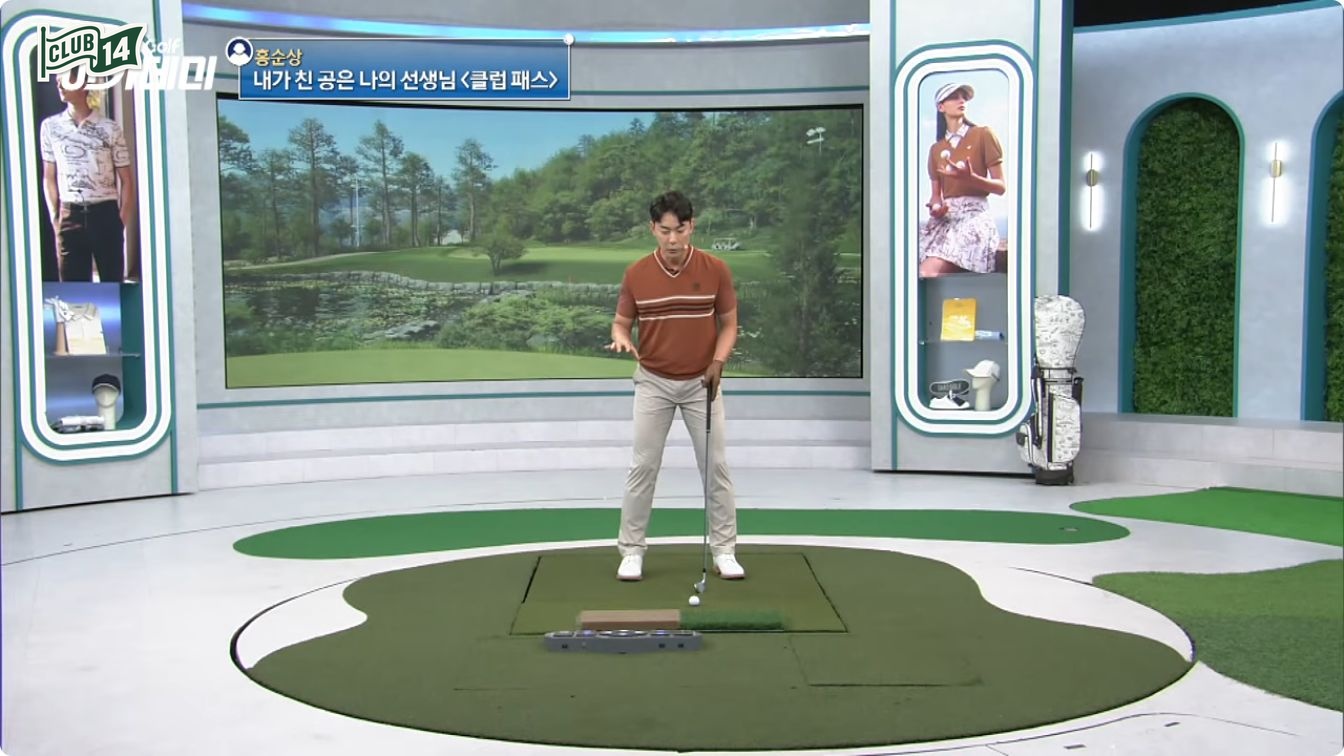
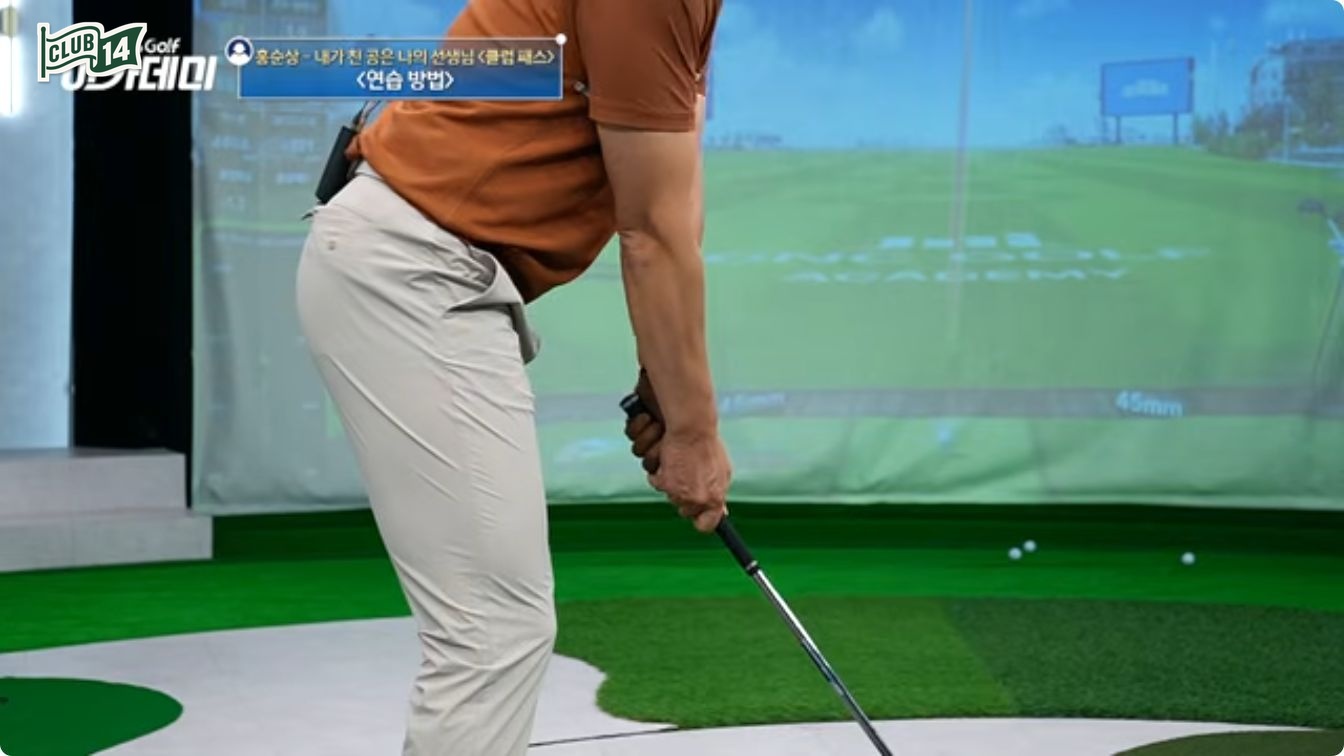
The feeling of movement here is very similar to the sensation in the pelvis when actually taking a shot. The important thing to note is that you should not try to rotate your upper body along with it. Upper body rotation is not necessary. You just need to move your pelvis entirely; surprisingly, you will feel your upper body naturally follow even though only your pelvis moves. Ultimately, you are not forcing yourself to rotate; rather, if you move your pelvis, your upper body follows that movement.
06Learn while sitting, and complete it while standing.
Once you have fully familiarized yourself with the movement of your pelvis while sitting in a chair, you can now move on to practicing while standing, mimicking the sensation of an actual swing. Place a chair behind you, find a suitable distance, and practice the motion with the feeling that your right hip is touching the back wall as you lift your backswing. Since the sensation is slightly different when sitting compared to standing, it is best to familiarize yourself with the feel while sitting first, and then complete the sensation of an actual swing while standing.
If you utilize your right hip well to maintain your axis like this, you will be able to completely correct bad movement habits such as hip thrust or early extension.
07Today's homework
The exercise I showed you today—moving your pelvis back and forth while sitting on a chair—can be done anytime, even while eating, as long as you have a chair, so please repeat it whenever you have a spare moment. When practicing while standing, place a chair behind you to adjust the distance, and practice the movement with the feeling that your right hip is touching the chair when you lift your backswing.
Today's homework is to familiarize yourself with the sensation while sitting, and then transfer that feeling while standing. If you repeat this, you will definitely get closer to a swing where your axis remains stable.