This article was machine-translated from the Korean original. Read the Korean original
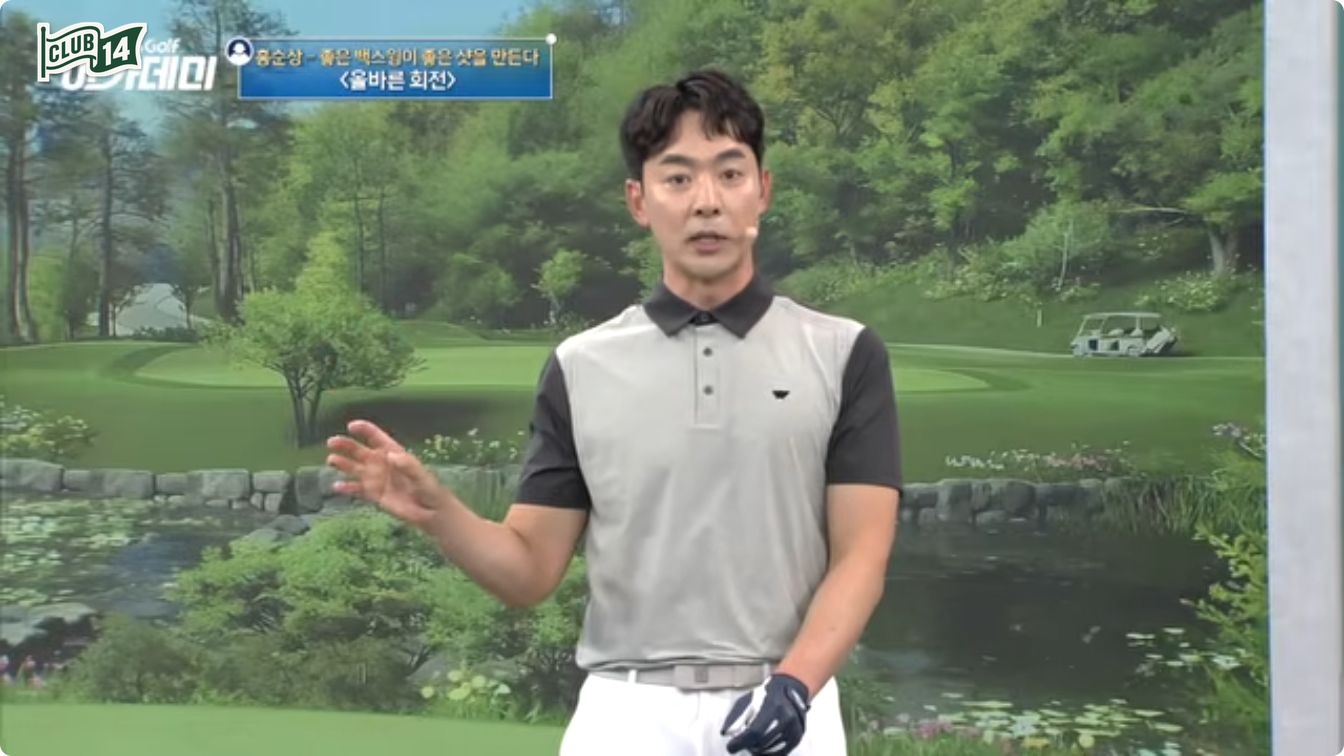
If you want to hit better shots and lower your score, there is something you must check. It is your backswing.
You usually focus a lot on the downswing and impact. However, the downswing and impact are actually determined to some extent by the backswing. The downswing is the result, while the backswing is the cause. Furthermore, once the downswing begins, there is actually not much you can control at that moment. Therefore, if you want to fix your downswing, you must first correct your backswing.
01Could I have a backswing like this, too?
There are a few incorrect backswing patterns I would like to point out. First is when the left knee pops forward, causing the left shoulder to lean forward along with it. When this happens, the weight remains on the left side, but during the downswing, it actually shifts to the right, causing you to hit the ball upward, which makes it impossible to hit a downblow.
The second case is when you start the backswing by keeping your upper body too fixed and relying solely on your arms. If you do this, your hands tend to spread outward at the top, making compensatory movements likely. Furthermore, since you started with only your arms, there is a high probability that the backswing will end up being completed solely by your arms.
The third case is when the body and club start off in harmony, but the upper body stops rotating and only the arms continue to be lifted. This impairs the path of the club head, inevitably causing deviations in the ball. Even those who pay special attention to their hand position end up using their hands too much anyway.
02It may look complicated, but there is only one thing to fix.
If you take a close look at the backswing, there are really many points where problems can arise. However, I want to tell you that if you correct just this one thing, many of the issues that can occur in the backswing will be resolved together. That is upper body rotation.
Even tour pros who hit the ball exceptionally well have different swing shapes. However, they do have one thing in common: they rotate their upper bodies sufficiently. The standard is as follows: at the top of the backswing, you must rotate enough so that the logo on your back is visible when viewed from behind, and as long as your left shoulder returns to its original position, it doesn't matter if it rotates further than that. Conversely, many amateur golfers continue to see the front of their upper body even after thinking they have completed the backswing; this is a sign that they are significantly lacking in rotation.
Visualizing an image is also helpful. Ever since I was young, I kept a mental image of a side profile shot of Tiger Woods at the top of his swing, with his left shoulder tucked sufficiently under his chin, and I tried to emulate that posture. In terms of physical sensation, I imagine my upper body above the belt line as a plastic bottle cap, and I create rotation by twisting the cap to tighten it. This is strictly my own personal image. If it feels comfortable for you to start with, it isn't a wrong method, even if it looks a bit odd to others. Finding an image that works for you is also a good practice.
03But why isn't it rotating well?
I believe the reason amateur golfers struggle with rotation is often due to the mindset that they must keep their bodies too rigid, rather than a lack of flexibility. In reality, even tour pros don't swing with the intention of fixing their lower bodies. Yet, to the eyes of an average golfer, it simply looks like they are holding their lower bodies firmly in place while hitting the ball.
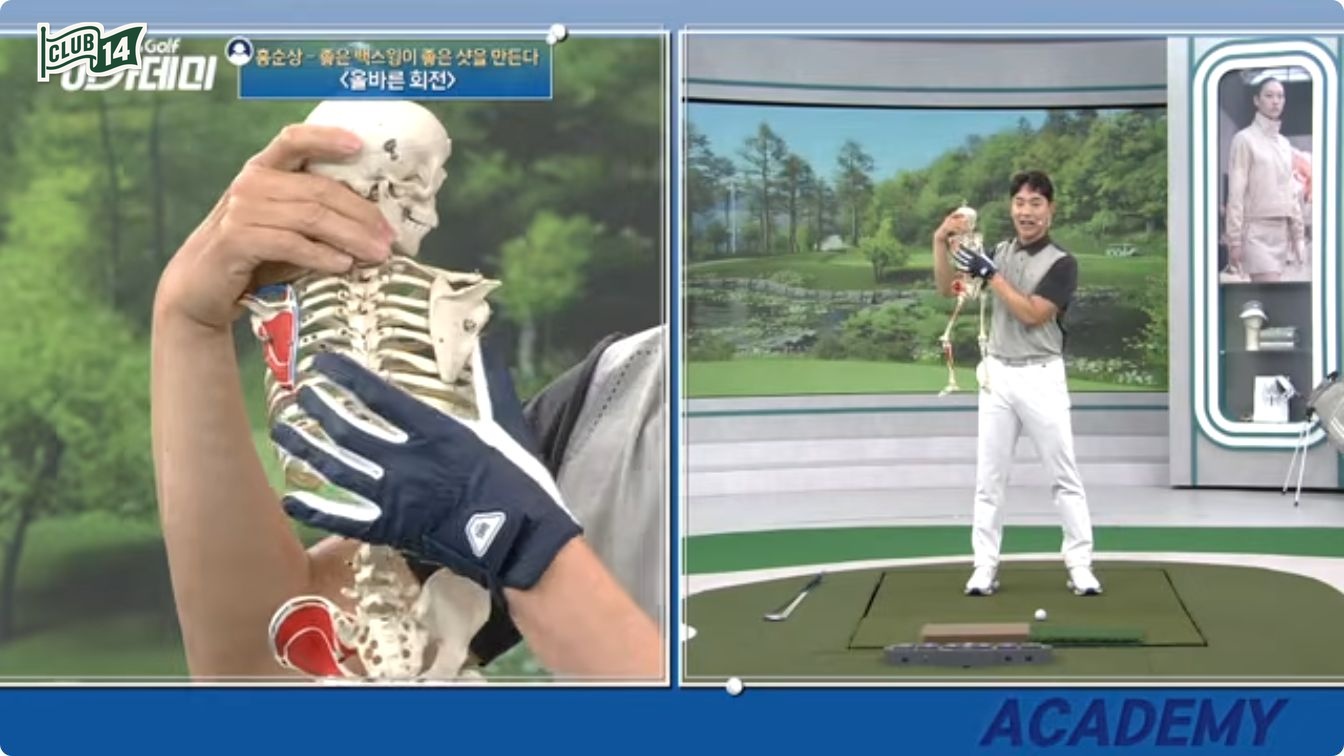
There is a structural reason for this in our bodies. Although the five lumbar vertebrae in the lower back are theoretically said to have a normal rotation range of about 10 degrees, it is said that almost no one actually rotates that much in reality. This is because the lateral joints are vertical, so even if one attempts to rotate, they get caught and cannot. The lumbar spine should be regarded as bones that hardly rotate.
The actual rotation occurs in the thoracic spine in the back, but even the thoracic spine cannot rotate much if the pelvis is held in place. If you try rotating only your upper body while holding your lower body in place right now, you will immediately feel that you cannot rotate sufficiently. Therefore, there is a specific sequence. The pelvis opens first to open up the body, followed by the rotation of the thoracic spine, and finally, the rotation is completed as the right shoulder blade pulls from behind and the left shoulder blade pushes forward. If you try to force rotation of the lumbar spine, which hardly rotates at all, it places a significant strain on the body and can lead to injury.
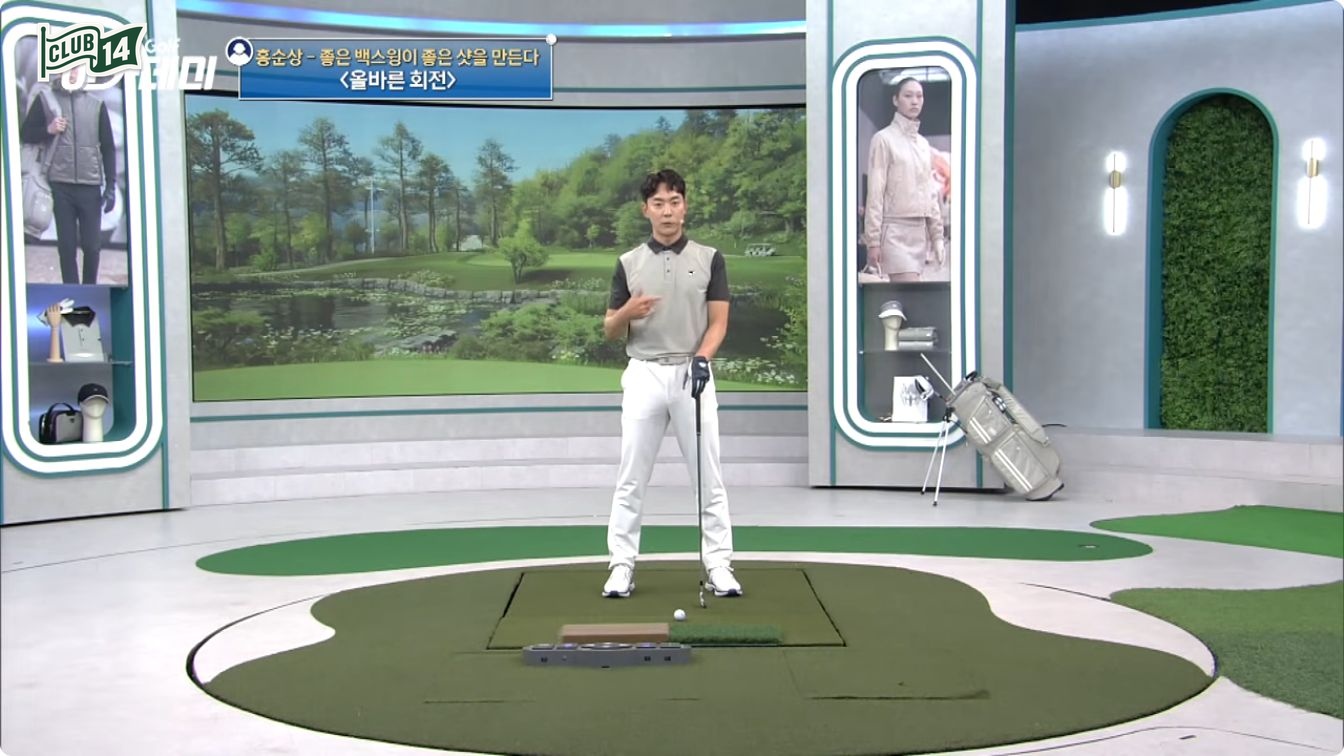
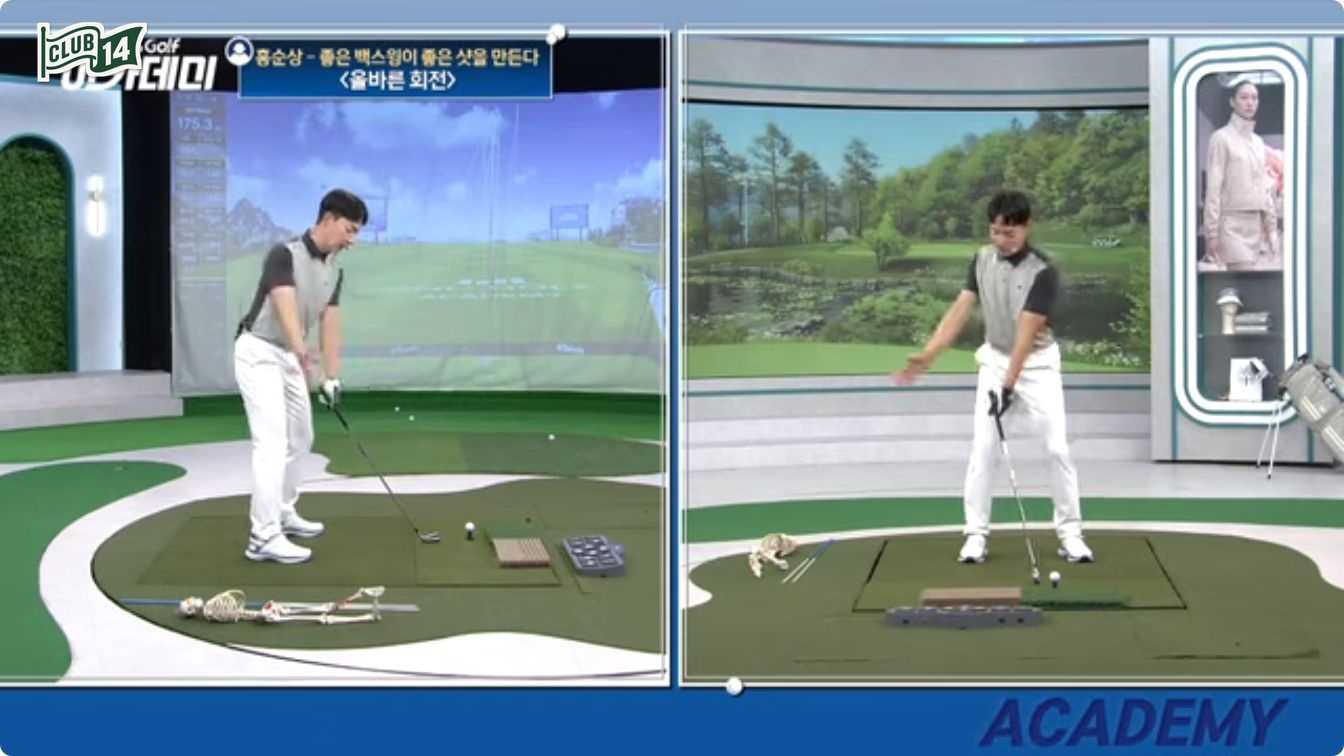
So, where should you rotate? The answer is the pelvis. Just as you open your left pelvis after impact, you should comfortably open your right pelvis when lifting the club during the backswing. The pelvis must open properly for the rotation above it to proceed smoothly and exactly as you desire.
04Three tires on the body
There is a good analogy for understanding the direction of rotation. Imagine three flat, cylindrical tires placed side by side. If even one of them is misaligned, the remaining tires cannot rotate properly and instead become misaligned and damaged. In our bodies, the shoulders, pelvis, and knees are these three tires. These three must rotate together in the same direction for the rotation to continue smoothly until the end.
Many people who frequently slice try to hit a draw by forcing a gentle trajectory with their hands. However, if you rotate your upper body sufficiently, that trajectory is created naturally. Conversely, if you do not rotate your upper body, the trajectory becomes steeper, resulting in a slice.
For the hands and club to be square during the takeaway, they should ideally be positioned slightly inside the target line. However, if the pelvis is blocked and does not open, the hands and club will either move outward or be forced to be pulled inward. The pelvis plays the role of creating a path for the hands and club to enter the square position properly, much like a manager guiding you to your seat at a restaurant.
05How far can I open it?
When people hear about rotation, there is something everyone wonders about: just how far should you open your body? The answer is simple. You can open your body boldly, trusting that your soles are fixed to the ground. Structurally, your knees and pelvis are prevented from rotating as much as your shoulders unless you lift your feet. If you trust the tilt of your upper body and the fact that your soles are on the ground, and open your body, your pelvis will naturally stop at the point where it catches.
The heel-up exercise that many people practice these days follows the same principle. Your body needs to move sufficiently to the right for your heel to lift naturally; forcing your heel up without any rotation isn't the real thing.
06Takeaway — The backswing can also be the result.
Up until now, the discussion has been about the backswing being the cause of the downswing; this time, however, there is a movement where the backswing itself becomes the result. That is the takeaway. Many people make the mistake of forcing the club up too suddenly during the takeaway. If you do this, the overall rhythm of the swing is bound to become stiff.
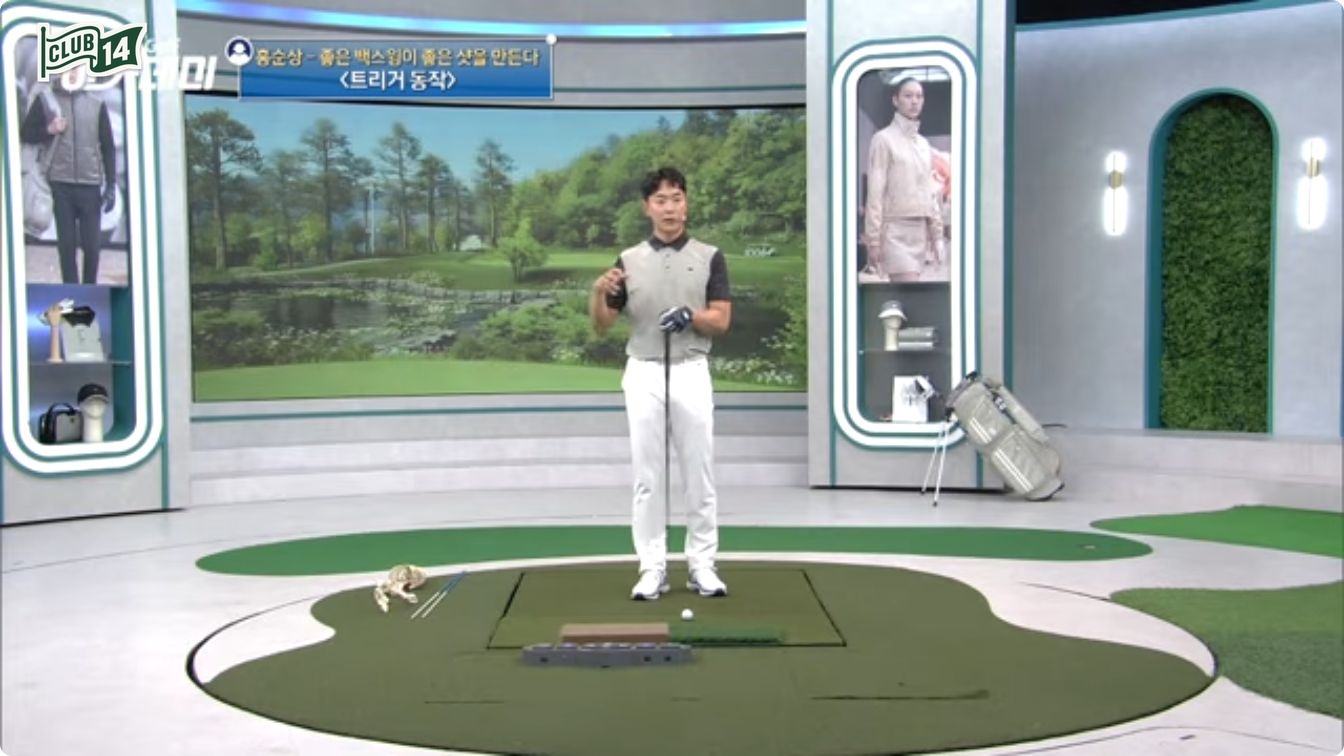
If you look at golfers with a good swing, they don't suddenly lift the club. Instead, they have small signals—or triggers—that they give to their bodies before starting the swing. These might involve slightly pushing their hands forward and then bringing them back, slightly pushing their knees forward and then bringing them back, or slightly shifting their weight to the right and then bringing it back. I start my swing by slightly shifting my weight to the right, while Sungjae Im starts by slightly bending and then straightening his knees.
Having a trigger allows you to start your swing smoothly, as if being tossed, rather than forcing the lift. It reduces tension and significantly improves your rhythm. It doesn't matter what form it takes. Having your own trigger helps with a stable backswing. Since moving suddenly after staying still makes the connection uneven, think of it as waking up your body with a slight movement beforehand.
07Today's Homework — Check with Alignment Stick
There is a practice method where you can visually check if the upper body rotation you learned today is being performed correctly. You will need two alignment sticks. If you do not have sticks, it is fine to substitute them with a tire-shaped object you have at home.
- One stick is on the belt lineInsert the stick at hip height to secure it.
- One stick on the shoulderAlign the two sticks so they are horizontally aligned.
- Place your body to the side rather than facing forward.It's okay if you don't actually hit the ball.
- Rotate and check if the two lines are parallelThe key is whether they are moving in the same direction together.
It is also helpful to be aware of common mistakes made during this exercise. One is when the pelvis rotates and drops downward, and the other is when people intentionally drop their left shoulder due to a misunderstanding that "the left shoulder should be low at the top." Doing so leads directly to the incorrect pattern where the left knee moves forward and the left shoulder tilts, inevitably putting strain on the left knee.
Simply repeating the process of creating this movement without hitting the ball and checking if the two lines are parallel gradually inputs the correct direction of rotation into your body. Changing your swing doesn't happen overnight; it is a change that occurs through the consistent repetition of this process of creating and verifying the movement.
If you don't have a stick shifter, you can really try practicing with a tire next to you. I also recommend recording yourself practicing to check your progress. Consistent practice is the only answer.