This article was machine-translated from the Korean original. Read the Korean original
A single, small movement can change the outcome. Just like the trigger of a gun or the starting signal in track and field, golf also has a trigger to start the backswing.
There is a question I get asked very often when playing a round or talking about golf with amateur golfers. They ask, "From the address position, exactly where and how should I move to start the backswing?" In fact, the secret to a good swing is hidden in this single question.
01A trigger is a signal that prevents the body from freezing.
While "trigger" originally refers to the trigger of a gun, in golf it refers to a small starting signal given to the body to initiate the backswing. The trigger not only serves to start the backswing but also plays a role in ensuring that the hands, arms, shoulders, and pelvis do not move separately but become a single, connected movement.
Without a trigger, there are times when the body freezes up in the address position. Both amateurs and professional golfers experience the frustration of being unable to start the backswing because the body is frozen. Sports psychology explains this by stating that it is due to the absence of a trigger. A trigger acts as a switch that tells the body, "Now is the time to stop thinking and start the swing."
02Why did athletes in the past move their lower bodies so much?
If you look at the swings of legends like Ben Hogan, Gene Sarazen, and Bobby Jones in black-and-white footage, their lower body movements are massive. They use their lower body so much that their left heel lifts off the ground, and this was the trigger to start the backswing.
However, starting around the 1980s, as arguments emerged questioning the need to disrupt a well-established stance, players began to increasingly start from a static position. The problem is that starting from too still abruptly results in poor rhythm for the club, arms, shoulders, and pelvis. It also delays the pelvis's preparation for the downswing. Conversely, starting with a slight rebound allows the pelvis to open and the club setup to be completed earlier, making the preparation much faster.
The same applies to other sports. In baseball, tennis, and basketball, applying a slight momentum when changing direction creates a much more efficient movement than starting from a standstill.
03Tiger Woods and Rory McIlroy, Different Triggers
Tiger Woods uses a 'forward press,' where he pushes his hands slightly forward before impact to initiate the swing. He applies this same trigger not only to his irons and driver but also to his wedges and putters. Because the hands move first and the movement of the torso's center is minimal, it is a trigger that helps with more precise control.
Rory McIlroy shifts his weight slightly to the right and moves the clubhead using the force of that shifted weight. Since the lower body acts as a trigger, he can utilize larger muscles, and by moving his feet before his hands, he generates greater rotation and power.
When I played on the U.S. Tour in the past, I took lessons from the same coach as McIlroy, and I remember that he also used a lot of forward press when putting back then. The coach emphasized that "having this kind of trigger allows you to make more confident shots in tense situations." However, the McIlroy these days doesn't send his hands forward as much when putting as he used to. I see this as a result of changes in equipment and course lengths. Small triggers like the forward press are advantageous for accuracy, but triggers that involve a large weight shift are advantageous for distance. I think that as courses get longer and the competition for distance intensifies, more players are choosing to shift their weight.
04Three conditions for a good trigger
There are various types of triggers. It doesn't matter whether you push your hand forward, shift your weight, slightly turn your head, or gently push with your right knee. However, I believe that for it to be a good trigger, it must meet three conditions.
- The movement should not be large.If the trigger becomes too large, it can disrupt the rhythm or create new movements. It is normal for it to be small enough that you wouldn't even notice a trigger when watching your favorite player's swing.
- You shouldn't rush.You must never rush, neither during the takeaway that initiates the trigger nor the moment of transitioning from the top to the down. If you rush, no matter how good the trigger is, it becomes an unfamiliar movement, and the connection between your body breaks.
- The entire body must be connected.It shouldn't be just the hands or shoulders moving; it must be an organic flow where weight is shifted, the pelvis reacts, the upper body rotates, the arms follow, and the club moves.
05Im Sung-jae's knee: Is it a trigger or a routine?
Im Sung-jae is famous for the motion of slightly bouncing his knee before the backswing. At first glance, this might look like a trigger, but I view it a bit differently. He doesn't start immediately after bouncing his knee; instead, there is a hidden movement of shifting his weight slightly to the right in between. I consider the knee bouncing motion itself to be more of a routine, while the actual trigger that initiates the takeaway is that subsequent small weight shift.
Ultimately, the purpose of the trigger is simple. It is not about forcing the club up, but about physically learning the feeling of the backswing naturally lifting as the weight shifts to the right, and the downswing starting as the weight shifts back to the left foot.
06Practice method using four balls
There is a practice method that allows you to simultaneously master the feel of this trigger and weight transfer. Line up four balls in a row. The spacing between them should be slightly less than a handspan. This is because if the spacing is too wide, it becomes difficult to move a full foot to the next ball, and having to move too much makes it hard to hit the ball.
Don't stop here; continue your swing and hit the balls one by one, but the key point is direction. You shouldn't hit while walking forward, but rather while walking from front to back. If you swing while walking forward, your right hip gets blocked, whereas if you swing while walking backward, you can properly feel your right hip opening up.
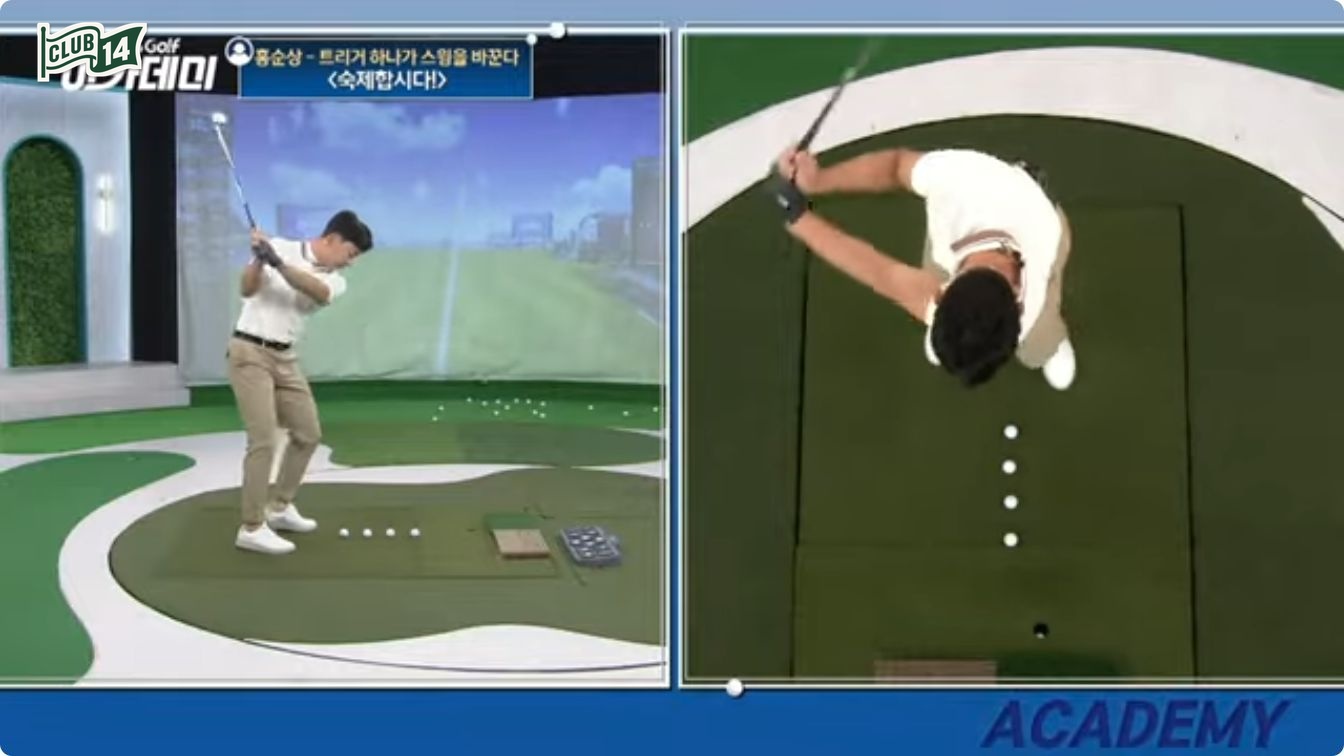
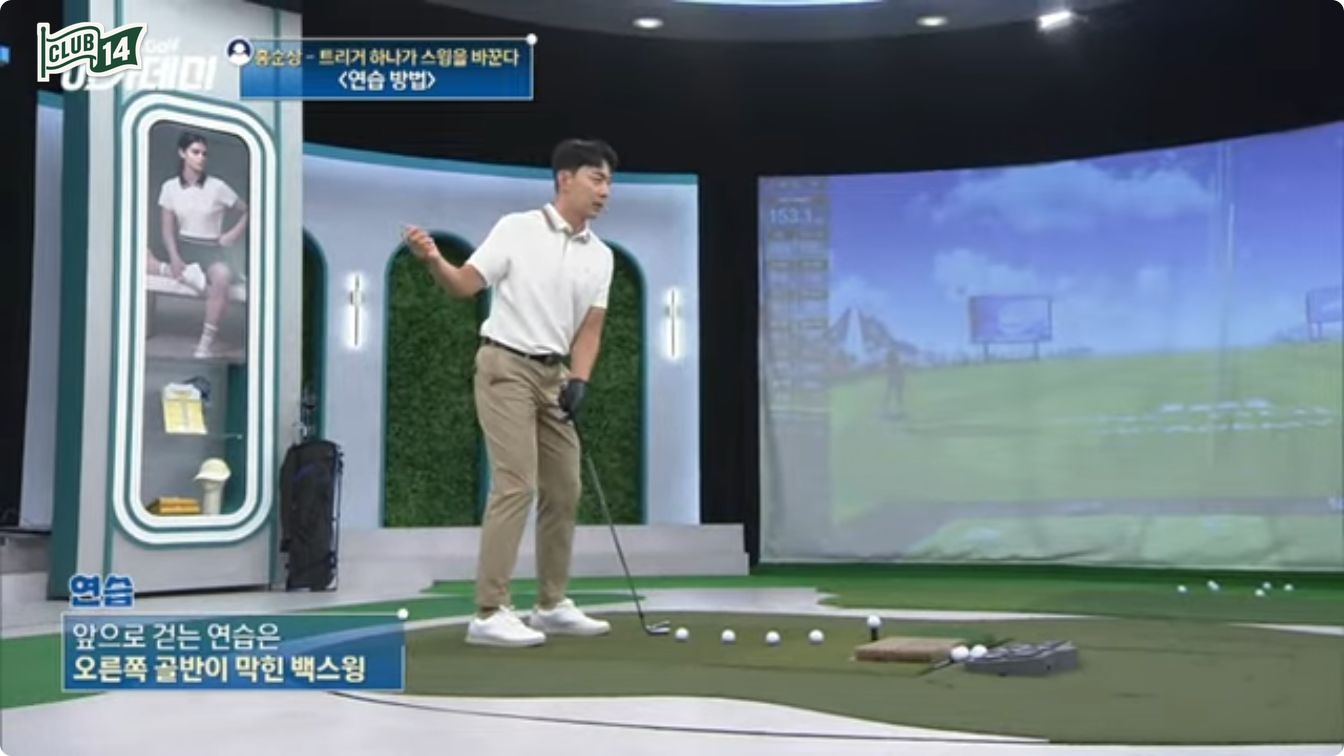
There are two things you need to feel at this point. The first is the feeling that you are not forcing it, and the second is the feeling that you just need to decide where to throw it. My explanation is that if your right hip opens up properly, the club will automatically throw to the desired location.
07When making a trigger with my hand, how far can I push it?
When many amateur golfers hear the term "trigger," they picture the motion of pushing the wrist forward to launch the swing, just like Tiger Woods. However, if you make this motion too exaggerated, it can easily turn into "hand play." Pushing the hands too hard can lower the club's loft or open the face, and even cause the shoulder alignment to become misaligned.
The standard is simple. You should only push until your arm and the shaft are in a straight line when viewed from the front. If you push further and there is still an angle remaining, you are not ready.
08Today's homework
Your homework is to try out the practice method you learned today. However, there is one condition: you must ensure safety first. Since this involves swinging while walking backward, you must make sure there is no one behind you. You should also check if anyone in front is practicing a draw shot, and if there is someone practicing in the opposite direction in the same space, it is best to reach an agreement before proceeding.
You can adjust the number of balls to fit the space available. If you have the room, it is also a good idea to increase it to four or five and hit them in succession. There is no single correct answer regarding the trigger itself. If you want accuracy, try using a slight forward press with your hands as the trigger; if you want a powerful swing, try using the recoil from shifting your weight to the right. I recommend that you find the trigger that suits you best by choosing between these two options yourself.