This article was machine-translated from the Korean original. Read the Korean original
When it comes to increasing driving distance, most people immediately think of weight training or speed training. I also had a time when I tried to build up my body that way. However, even with all that effort, it often leads to an inconsistent swing or injury. In fact, driving distance is much more often determined by efficiency than by power.
Today, instead of talking about how to build power, I’m going to tell you about increasing your total distance by changing your ball flight while maintaining the same speed. Even if your carry remains the same, the total distance changes dramatically if you improve the roll after landing.
01Why Draws Save Runs
When I was aiming for a win, I primarily used draw shots with both my driver and irons. This was because hitting a draw with the driver provided a significant advantage in terms of distance. A draw has less spin and generates a lot of roll because it has strong forward momentum after landing. It is not that the carry distance itself increases, but rather that the total distance traveled further by adding the roll.
With irons, it is advantageous to hit the ball with the desired carry distance to stop it, but with a driver, there is no reason to stop it exactly where it lands. Therefore, a draw shot that rolls far is much more advantageous for a driver.
02There are only two ways to make a draw run.
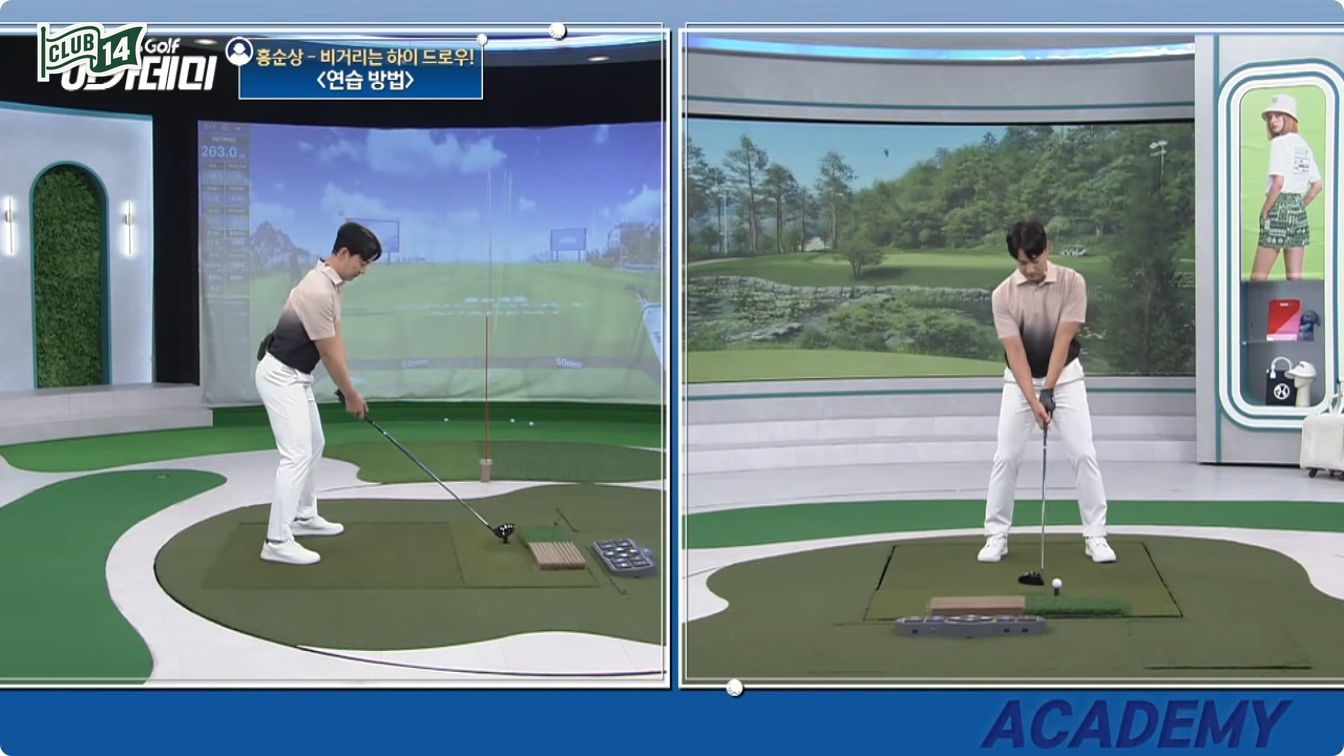
The first step is alignment. Since the ball is going to curve to the left, you need to set your direction to the right. It is important that your stance, pelvis, and shoulders follow the line of your feet together. You can also use the bunker at the edge of the hole as a good target. Since there are many out-of-bounds spots in Korea, landing in a bunker can actually prevent a major miss in some cases.
The second point is the backswing top. When viewed from the side, if you create a low top where your left arm is as close as possible to your shoulder line, you can achieve a smoother swing path. You should lift your hands with the feeling that they do not rise above your shoulder line. However, you should not rotate as if you are pulling your hands; instead, it should feel like your hands move along with your body's rotation.
Some people obsess over the idea that you must keep your left shoulder low and try to intentionally drop it, but if you just stand at address properly, this height difference will naturally occur during the rotation process.
03Slice worries, try turning your thinking around.
When you first start playing golf, it is common to hit fade-type slices. Changing your ball flight is a matter of your swing, but it is also essentially about changing your visual image. Those who slice frequently try to send the ball to the left to avoid curving to the right, but the more you do so, the wider the curve becomes as the ball spins to the right. Conversely, the more you worry about missing to the left, the more you need to open your body to avoid that mistake. You need to break this mindset at least once.
04'High' isn't about rising, it's a low spin.
When people hear the term "high draw," they often think they are only trying to loft the ball, but that is not what I mean by "high." Even pros don't particularly like the type of shot that amateur golfers frequently see, where the ball rises and gets higher.
The high draw I am talking about is a shot that travels further with low spin, tracing a parabolic arc while having reduced spin. Simply reducing the spin actually makes a high trajectory advantageous. It improves carry distance and is beneficial when clearing obstacles like bunkers; with the added roll, the total distance definitely changes.
05If the body opens up too quickly, the run also decreases.
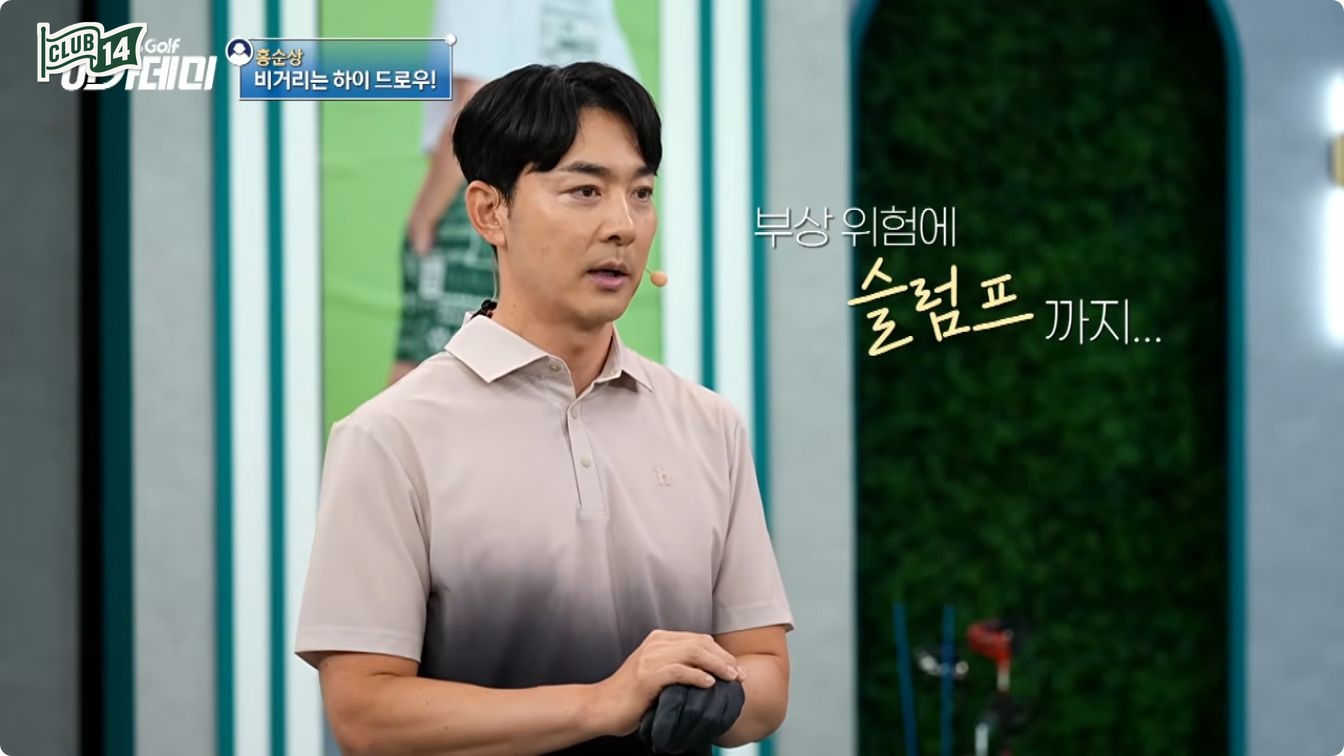
Simply making the top of the swing low doesn't guarantee a draw. If your body opens up too much, the release timing will be delayed, potentially causing the ball to fail to curve to the left. While it's okay to have your upper body slightly open at the moment of impact, you should swing with the feeling that your hands, clubhead, and arms are passing through your body while keeping your body as close to the ball as possible.
There is a practice method to master this feeling. Hold the driver upright and stabilize it with your left arm. While standing at address, try swinging using only your right arm. Since your left arm is blocked, your upper body does not open up, allowing you to accurately feel the sensation of your arm passing through. Repeat this about five times, trying to feel the direction of your upper body and the timing of your arm's movement.
06How to increase the trajectory after the run
Once you have mastered the draw to some extent, it is time to increase both carry and total distance by raising the trajectory slightly. The swing remains the same. It is sufficient to simply tee the ball a little higher and shift your weight slightly to the right at address. It is helpful to start the swing with the image in mind of launching the ball very high and creating a large curve.
07Practice checking the starting direction
To execute a draw, the ball must clearly start to the right. If it starts toward the target, it is already close to a miss. Place an alignment stick to the right of the target line and practice starting the ball to the right of it. If you do not have a stick, you can set up an object that might be slightly visually inconvenient, such as a ball, a tee, or a plastic bottle.
08Today's homework
Place a reference object at least one step away from the ball. Then, if you start the ball to the right of that object three times in a row, you have succeeded in today's homework. I hope you experience firsthand how the carry, as well as the run, can be enhanced with the same amount of force.