This article was machine-translated from the Korean original. Read the Korean original
There are times when it feels really strange while playing golf. You find yourself repeating the same mistakes only on specific holes or in specific situations. This is usually called a jinx—making mistakes on the first or 18th hole, or hitting a bogey or out of bounds right after a birdie. You know the saying, "You pay for your birdie." I think many of you can relate to this.
However, I am not trying to bring up your painful memories again. First of all, I want to tell you that every golfer is bound to experience situations like this. So, please stop thinking, "Why am I like this?" and instead, the first step to overcoming a jinx is to adopt the mindset that "I can overcome this, too."
01Why do jinxes repeat?
If you are a golfer, you are bound to experience the worst shots you ever want to go through again. These memories lie dormant in your subconscious and, unfortunately, surface at crucial, decisive moments. Then, another mistake follows; the next time the same situation arises, your hands and feet sweat, your whole body stiffens, and you make yet another mistake. And then, you become convinced: "This is the only way I can handle situations like this." It is a problem that cannot be solved by practicing twice or three times as much, or by overhauling your swing.
02The solution is routine, not superstition.
I’ve actually been swayed by superstitions myself. I went to a tournament in Jeju Island a while ago, and seaweed soup was on the pro-am menu. I held back because I remembered hearing that you shouldn't eat seaweed soup before a competition, but when I saw the players ordering it that day, they all got eliminated in the qualifiers. After that, I stopped eating it altogether. It was a fun experience, but prevention is always important. And in golf, there is a real preventative measure. That preventative measure—which can put a playing partner in their place right after a birdie on the 1st and 18th holes, if they believe you’re going to make the same mistake again—is the pre-shot routine.
03Hong Soon-sang's Pre-Shot Routine
A pre-shot routine is a consistent and repetitive preparatory movement performed before hitting the ball. If you watch players in action, you will see that the movements before hitting the ball are repeated exactly the same every time, even more so than the swing.
Let me tell you about my routine. I do two practice swings. The first time, I focus on the technical aspects, and the second time, I swing in one continuous motion from backswing to finish. I consider the moment I finish my practice swing and look at the target from behind the ball to be the start of my pre-shot routine. It doesn't matter what I do before that. I find a spot not too far from the ball—like a divot or a patch of grass of a different color—to set a target point, visualize the ball I want to hit from behind, and then walk in while gripping the club. I align myself while looking at that point and the target, and after glancing at the target once or twice and my gaze returning to the ball, I start immediately.
04The key is 3 seconds — before the target image disappears
To be precise, it is 3 seconds. When you look at the target and your gaze returns, the last image of the target remaining in your mind disappears in about 8 seconds. It doesn't vanish instantly at exactly 8 seconds, but rather gradually fades after your gaze has left. Therefore, it is best to start when that image remains at its clearest.
Some golfers look at the target with the club pad resting on the ball, allowing them to start immediately once their gaze returns. If you hold the club head slightly up like me, you need to lower the club a little before starting; even in those cases, it is fine as long as you start within three seconds. If you take too long, you start to tense up and distracting thoughts creep in—like worrying about the 18th hole while playing the 7th, or thinking, "I can't go out of bounds." The key is to start the swing before those thoughts cross your mind.
05Rory McIlroy was no exception.
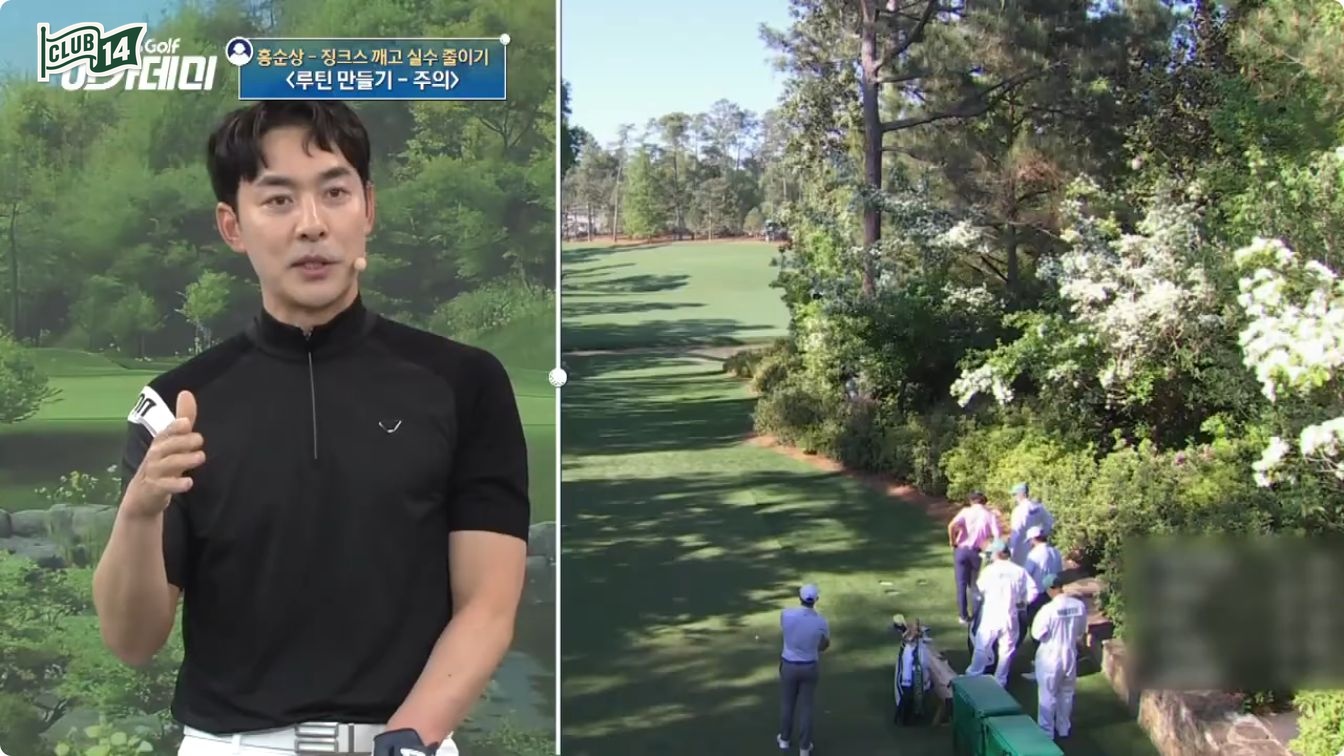
Rory McIlroy won the 2026 Masters, didn't he? However, try looking up the video of his tee shot on the par-5 13th hole of the second round. Although he made a birdie on that hole, his tee shot drifted to the right and landed in the pine forest. McIlroy's usual routine involves looking at the target four or five times and not moving too fast, but on that hole, he missed his normal timing to start and looked at it one more time, resulting in that shot. He finished with a birdie thanks to a good third shot and putt, but if this had been a Korean golf course, it could have easily resulted in an out-of-bounds shot. When a player's routine deviates from their usual timing, it is a sign that something is uncomfortable and is likely to lead to mistakes.
06Two things to keep in mind when creating your own routine
There are two things to keep in mind when creating a routine. First, it shouldn't be too elaborate. You don't need to make it into a ritual like squeezing your armpits and tucking your right arm under; keep it short and concise so you can always repeat it easily. It doesn't matter if you do a practice swing or not, or if you look at the target once or four times.
Second, the key to today is to start the takeaway without delay or hesitation once your gaze returns to the ball after looking at the target for the last time. It doesn't matter how many elements are involved, but once your gaze returns, you must go immediately.
07How to practice with a timer
I set a desired time on a smartphone timer app and practice repeatedly. I always set it to 18 seconds, as repeating the same motion within the same amount of time is really important. I once read an article about how even Tiger Woods missed a victory because he was just one second late and missed a shot. That shows just how helpful it is to practice with a set timer.
Also, try practicing a separate exercise where, once your gaze returns to the ball, you stop thinking about the swing and just start the swing immediately. I usually do this training by hitting about ten balls in a row, but this is all about habit. It is absolutely necessary to train yourself to just start the swing before you even feel like you aren't ready yet.
08Today's homework
I also played very slowly in the early days of the tour. Driven by my desire to play well, I would look here and there, wanting to weigh my moves one more time. After making a critical mistake, I realized that the solution was a routine, and since then, my speech has gotten faster and my play has improved significantly.
- Set aside some time for yourself.Please set the timer to 20 seconds or any time you want.
- three balls in a rowYou succeed if you complete the same movement three times in a row within the same time. I will allow a margin of error of up to one second.
Having this pre-shot routine will serve as a pillar of support to keep you grounded when you feel nervous on the course.